
By Jennifer Gilligan, IntegraMSP President
Let’s just call it what it is — maddening.
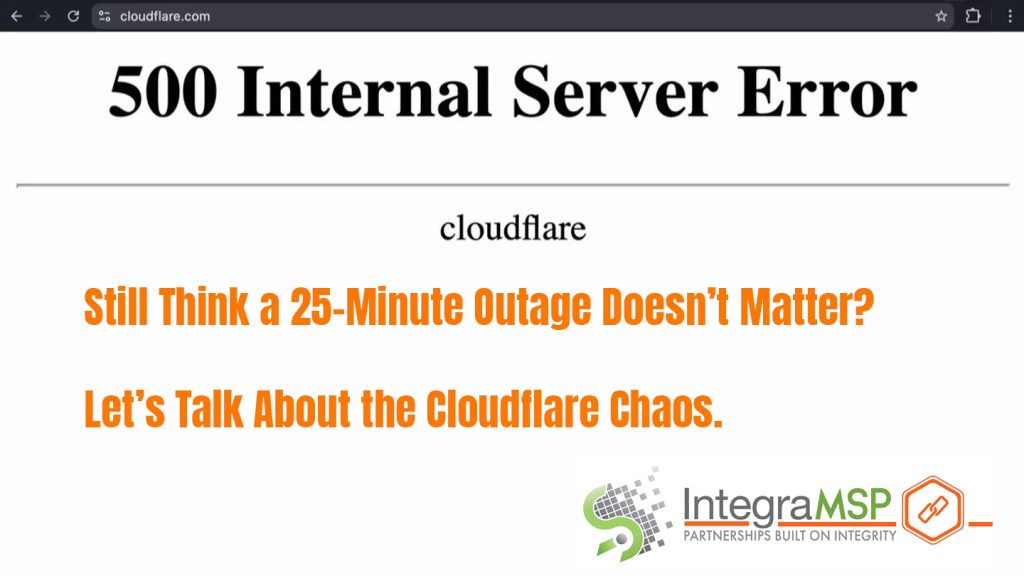
On December 5th, the internet decided to throw another tantrum. Cloudflare — the behind-the-scenes tool that helps keep half the web up and running — pushed out a faulty update, and suddenly it felt like the digital floor dropped out from under us. Again.
Zoom? Down. Canva? Broken. LinkedIn? Glitching. If your team was mid-project, in a meeting, or wrapping up a proposal when things froze? Yeah, we felt that too. It’s not just frustrating anymore — it’s exhausting.
Why does this keep happening?
This wasn’t a cyberattack or some sophisticated threat actor. It was a bad Web Application Firewall update. The very thing designed to protect websites? It accidentally took them out. For the second time this year.
Source: Forbes
So now we’re left asking: how can something this big, with this much responsibility, break so easily — and so often?
And more importantly: what are the rest of us supposed to do while we’re left holding the bag?
Lesson #1: If you’re relying on someone else’s system, you’d better have a backup plan.
Most business owners have never heard of Cloudflare. But their websites, scheduling tools, portals, and apps are all tangled up with it. So when it crashes? Your entire digital front door slams shut.
And let’s be clear: your clients don’t care why it happened. All they see is you, offline, at the exact moment they needed something from you.
Lesson #2: “It wasn’t our fault” doesn’t save face with clients.
They don’t want an apology paired with a tech explanation. They just want access. They want to finish uploading a file, schedule a call, or get their invoice.
When that doesn’t happen, it doesn't matter if the problem was “third-party infrastructure.” To them, it looks like you dropped the ball. And when that happens too often? They quietly start looking elsewhere.
Lesson #3: Stop hoping it won’t happen again. Plan like it will.
If your fallback strategy for tech failure is “we’ll deal with it when it happens,” you're playing a dangerous game. Resilient businesses don’t wing it — they prepare for it.
Here’s what smart teams are doing:
- Setting up real-time monitoring so they’re not the last to know
- Having pre-written outage updates ready to go
- Giving clients alternate ways to reach them if the usual tools go dark
This isn’t overkill — it’s basic ops hygiene in 2025.
Let’s talk about the excuses…
“It was only 25 minutes — is that really a big deal?”
Tell that to the business that lost a major lead during that downtime. Or the nonprofit that couldn’t process donations when their site glitched out. In our world, 25 minutes can be the difference between closing the deal or losing the client.
“It wasn’t us — it was Cloudflare.”
Sure. But your clients aren’t emailing Cloudflare. They’re emailing you. And when you can’t deliver, even if it’s not your fault, you still own the experience.
Wrap-up: We’re all tired of these outages. The only fix is readiness.
The internet is messy. Even the biggest infrastructure players screw up. And we’re not here to panic about that — we’re here to prep for it.
Because the next time something goes sideways, the last thing you want is to be caught flat-footed. That’s where we come in — helping you turn tech chaos into calm, strategic control.
Let’s make sure you’re the business that stays visible, stays responsive, and keeps earning trust — no matter what goes offline. Give us a Call.