By Jennifer Gilligan - IntegraMSP President
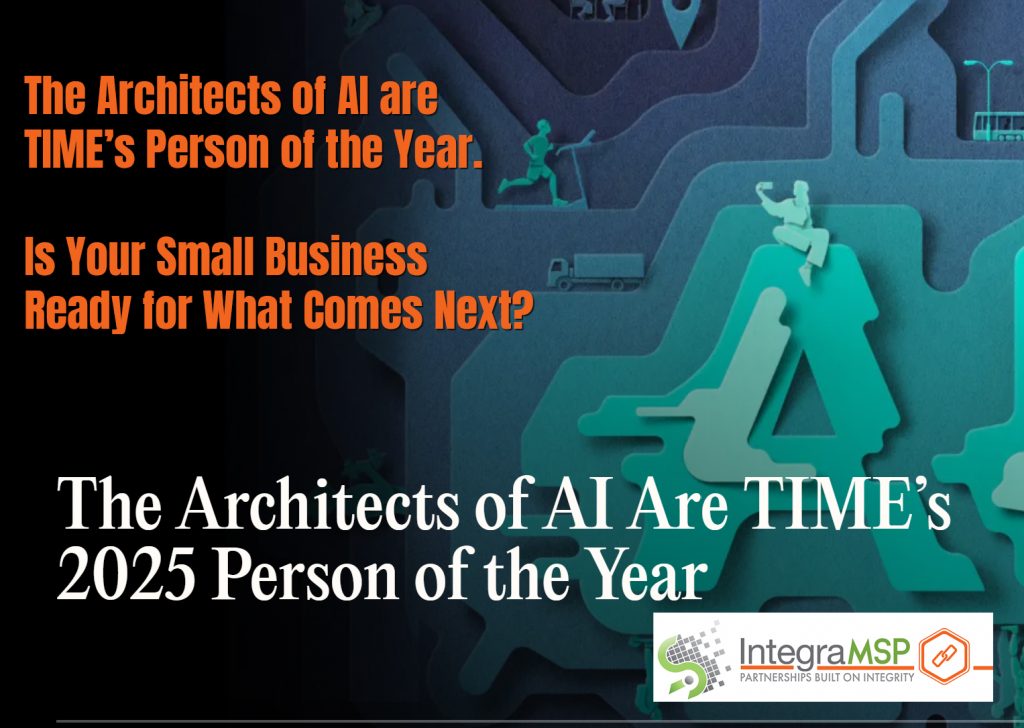
AI has officially gone from “someday” to “everywhere.” TIME naming the Architects of AI as Person of the Year was the moment the rest of the world noticed, but small businesses have been feeling this shift for a while now. It’s happening quietly, inside everyday work, through tools people already use without thinking about it.
For most SMBs, this didn’t arrive with a training session or a strategy meeting. It just showed up on everyone’s screens. And now the ripple effects are showing up too.
Customers expect quicker responses. Teams expect easier workflows. Owners expect more efficiency without adding headcount. None of these expectations are written down anywhere, but they’re there, shaping how people judge the experience of doing business with you.
And that raises a bigger question. If AI is already influencing how our teams work and how our customers behave, what does “responsible use” look like in the real world?
Most small businesses are already using AI. They just haven’t talked about it yet.
The funny thing is that AI adoption often starts from the bottom up. Employees use it to get through their inbox. Managers test it on reports. Someone experiments with marketing content late at night. No one announces this. It’s just what people do when the tools are convenient and the workload is heavy.
The risk isn’t that people are trying new things. Innovation has always been a strength of small businesses. The risk is that these tools are being used without clear guardrails. Not because people are careless, but because everything is moving faster than anyone expected.
That’s how you get inconsistent messaging or accidental data exposure or workflows that feel great in the moment but create bigger problems later. None of this is intentional. It’s simply the reality of how quickly AI has entered the mainstream.
Right now, small businesses don’t need more tech. They need clarity.
There is so much noise around AI that people assume they either need to overhaul their business or risk being left behind. That’s not the real story.
What small businesses actually need is a clear understanding of where AI fits today and where it does not. They need simple guidance that protects their data and their customers. They need someone who can translate the flood of possibilities into practical decisions that make sense for their size, pace and risk tolerance.
That’s where service providers like us show up right now. Not to build fully automated operations or resell complex AI systems. Not yet. Our role today is to help businesses move through this moment with intention instead of reacting to every new headline or tool.
Automation will come later. Responsible habits come first.
There will be a time when small businesses want deeper automations and integrated AI components. That moment is approaching. But it is not the entry point.
The first step is making sure the team understands the tools they are already using. It’s setting expectations, writing simple policies, and making thoughtful decisions about which workflows are safe to augment.
Once that foundation exists, the future becomes much easier to navigate.
Here is the question I keep coming back to.
If AI is already woven into the way we work, how do we make sure it supports the business instead of steering? How do we adopt with thoughtful intention? How do we foster innovation while ensuring security?
That is the conversation I want more business owners to have. Not a conversation about hype or fear, but about intention and responsibility.
AI is here. It’s already influencing your business whether you’ve planned for it or not. The opportunity is to take a breath, understand what’s happening, and use it with purpose instead of pressure.
I would love to know how other owners are approaching this moment. What are you seeing inside your teams? What feels exciting, and what feels unclear?
This is one of the most important conversations of the next decade, and small businesses deserve to be part of shaping it.