February 2026 Newsletter — IntegraMSP Support Portal, Product Scarcity, 2026 Tech Trends 🖥️🔮💌

2026 is clearly not easing anyone in gently. Between breakneck tech developments and weather that seems determined to keep us guessing, it’s already been a year for the record books. So this month’s newsletter is pulling double duty and covering both January and February. Why? Because the same surprise weather that disrupted half the country also stranded me out of town and derailed the January issue. Consider this the efficient, slightly weather-worn, but fully recovered edition.

This month, we’re spotlighting the IntegraMSP Support Portal — which we genuinely hope everyone is using, because it’s a powerful tool that makes getting help faster and far more efficient. We’ll also touch on what we’re seeing with ongoing hardware procurement challenges, along with a few tech trends that are already shaping 2026. And we’ll wrap up with a roundup of articles we’ve shared over the past six weeks in case you missed them — including one about how AI apparently has its own social channel now. (Spoiler: humans were not included on the guest list.)

As always, we love your feedback and ideas, so please feel free to send them our way!

Jennifer Gilligan - IntegraMSP President

And now - On with the show!:

Join our Mailing List!

IntegraMSP Support Portal

Below is a video tutorial on how to use the IntegraMSP Support Portal. Through our support portal you are able to access:

  1. Your Support Tickets
  2. Enter Support Tickets
  3. Find knowledgebase articles
  4. Access Application downloads
  5. Important Service Messages
  6. Courses for company products
  7. Company Directory
  8. Chat with IntegraMSP Technicians

Link to Portal.IntegraMSP.com

IntegraMSP Support Portal


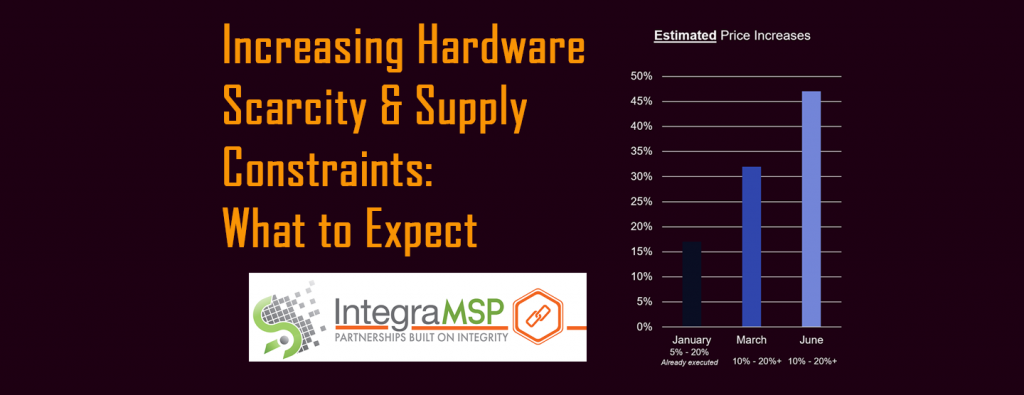
Hardware scarcity is increasing across the technology industry, and it’s no longer theoretical. Availability is tightening, pricing pressure is building, and lead times are becoming less predictable. If you’re responsible for planning technology purchases, the timing of decisions now matters more than it has in years.

This isn’t a single-vendor issue. It’s a broader market shift already underway.

What’s actually driving this

Across the global hardware market, demand continues to rise while supply tightens. Core components—memory, storage, processors—are under sustained pressure as manufacturers redirect capacity toward higher-margin, AI-driven infrastructure.

The downstream effect is simple: fewer available configurations, more variability in pricing, and less tolerance for last-minute decisions.

What we’re seeing on the ground

From an operational standpoint, hardware procurement is becoming harder to predict in two key ways:

  1. Pricing is less stable.
  2. Availability is less reliable.

As a result, quotes increasingly reflect what’s available and priced on the day they’re issued, not what might be available weeks later.

In practical terms, this shows up as:

  • Fewer configuration options for popular devices
  • Longer or shifting lead times
  • Pricing changes between planning, quoting, and ordering
  • Limited replacement options when a specific model goes out of stock


The biggest risk right now isn’t disruption—it’s assuming procurement will continue to work the way it always has.

Read More Here


Crystal Ball Predictions: The 10 Most Positive Tech Shifts Coming in 2026

We started out January with a look at what we see as 10 positive shifts in technology and then we deep dived into the top 7 areas to share how tech is being used for good in 2026.

1. Technology Becomes Proactive Instead of Reactive

For decades, technology has largely been reactive — responding to problems after they occur. In 2026, that changes in a meaningful way. Across healthcare, finance, education, cybersecurity, and logistics, systems are increasingly designed to anticipate needs before they escalate into crises. Predictive analytics, machine learning, and real-time data integration allow platforms to flag risks early; whether that’s a looming mental health concern, a potential fraud event, a learning gap, or a supply chain disruption.

2. AI Fades Into the Background (And That’s a Good Thing)

In 2026, the most effective AI won’t draw attention to itself — it will operate quietly in the background, improving experiences without demanding constant interaction. Rather than flashy standalone tools, AI is increasingly embedded into the systems people already rely on: calendars that automatically optimize schedules, navigation apps that reroute seamlessly around disruptions, healthcare platforms that surface the right insight at the right moment, and learning tools that adjust to student progress without adding complexity. This shift reflects a broader move toward what many are calling “invisible AI”; intelligence that enhances outcomes without interrupting the user experience.

3. Personalization at Scale Finally Delivers Real Value

Personalization has been promised for years, but 2026 is when it becomes genuinely useful rather than gimmicky. Advances in AI allow systems to adapt in real time — tailoring education to how someone learns, healthcare to how someone responds, banking tools to how someone manages money, and personal assistants to how someone actually lives.

4. Mental Health Support Becomes Embedded in Daily Life

Mental health technology in 2026 looks less like a separate app and more like a built-in layer across daily systems. Schools, workplaces, healthcare platforms, and wearables increasingly incorporate passive indicators of stress, burnout, and disengagement which allows for earlier support and intervention. -Reducing Burnout in Your Business with Embedded Mental Heath Support

5. Learning Becomes Lifelong, Flexible, and Human-Centered

The idea that education ends in early adulthood continues to fade in 2026. Instead, learning becomes modular, ongoing, and responsive to life changes. Short-form credentials, AI-assisted tutoring, and skills-based education allow people to reskill without uprooting their lives or careers.

6. Banking Shifts From Transactions to Financial Wellbeing

By 2026, many financial institutions are measured not just by efficiency, but by how well they help customers avoid stress and instability. Predictive alerts, AI-powered financial assistants, and smarter fraud detection allow people to manage money proactively; avoiding overdrafts, missed payments, and unnecessary penalties.

7. Logistics and Mobility Become Nearly Invisible

In 2026, logistics technology isn’t a separate system people have to think about. It simply works in the background, making everyday life smoother. Across industries, logistics has been reimagined to be more adaptive, transparent, and intelligent. Instead of focusing only on cost savings, organizations are building logistics networks that prioritize reliability and flexibility, helping goods and services move with fewer disruptions and more predictability.

8. Small Teams Gain Outsized Impact

In 2026, artificial intelligence continues to break down barriers that once favored only the biggest players. Tools powered by AI now allow individuals and small teams to build services, launch products, and tackle real problems without needing huge teams or massive budgets. From marketing automation to customer insights and content creation, AI levels the playing field so small organizations can compete more effectively with much larger ones. This trend doesn’t just help businesses grow, it helps them compete in ways that were previously out of reach.

9. Trust and Transparency Become Competitive Advantages

In 2026, as technology becomes part of how we live, work, learn, and connect, trust isn’t optional — it’s essential. People aren’t just looking for products that work well, they want systems that are clear about how decisions are made, how data is used, and how they’re protected. Companies that invest in explainable AI, ethical data practices, and built-in security are the ones earning and keeping user confidence. Trust becomes something organizations have to show, not just claim.

10. Technology Gives People Their Time Back

In 2026, one of the most meaningful changes brought by technology isn’t a flashy new product or futuristic device, it’s the simple fact that people are reclaiming time. Smart devices and connected systems are quietly taking over routine tasks that used to demand constant attention and decision-making. Things like thermostats that learn daily habits, robot vacuums that clean on their own, appliances that adjust settings automatically, and calendars that sync across devices all chip away at small chores and interruptions that used to eat up our days. By handling repetitive work and reducing mental load, these tools create little pockets of time that people can actually use for what matters.


💔 The Top 5 Tech Heartbreaks of 2025 (And How We Fix Them)

February is the season of love… and let’s be honest, also the season of learning things the hard way. In tech, 2025 delivered more than a few heartbreaks—most of them painful, awkward, and completely preventable. And 2026 looks to be on track to be just as painful.

The good news? None of these are fatal flaws. They’re fixable. We’ve been helping clients clean up the mess, rebuild trust, and put better guardrails in place.

Here are the Top 5 Tech Heartbreaks of 2025, what went wrong, and how smarter IT strategy keeps history from repeating itself.


Blue robotic hand holding a pink ring box with a diamond engagement ring inside, isolated on a white background. Concept of technology in love.

When Shadow IT Gets Engaged Without Telling Anyone

There’s a particular kind of tech heartbreak that doesn’t start with an alert, an outage, or a breach notification.

It starts quietly.

A team signs up for a new AI tool to move faster. Someone shares files through a platform that feels easier than the approved one. A department adopts a SaaS app because it solves a real problem — and nobody thinks to loop IT in.

By the time leadership finds out, the damage isn’t dramatic, but it’s real.

Find out the Heartbreak Here


AI Gets it's own Social Network - no humans allowed

For years, we’ve been asking AI to watch us.

Monitor social media.

Analyze sentiment.

Track behavior.

Summarize what everyone else is saying.

And now… the tables have turned.

AI agents launched their own social network. They post. They comment. They form communities. Humans aren’t allowed to participate.

We just watch.

It’s called Moltbook, and it looks a lot like Reddit—except it’s bots talking to bots, debating consciousness, sharing memes, and occasionally discussing their humans the way we discuss “users.”

Which is kind of delightful.

A security flaw popped up (because of course it did), reminding us that no system—human or machine—escapes the need for basic guardrails.

That’s not the punchline - it's more of a pattern.

The punchline is this:

We built AI to observe social behavior at scale.

Now we’re observing them doing it.

Same curiosity. Same messiness. Same need for rules.

It turns out the future isn’t a dramatic takeover. It’s a quiet role reversal where we sip coffee, take notes, and realize we’re still very much responsible for how these worlds are built.

Enjoy the view from the observation deck.

Learn about Moltbook


a nearly crying baby, a boy, a child in business outfit with suit. Generative AI

When the Vendor Said it was Secure (And it Still Went Wrong)

There’s a specific kind of tech heartbreak that feels especially unfair.

You did your homework. You chose a reputable vendor. You trusted the platform everyone else was using.

And then you found out they were breached — and your data was part of the fallout.

This isn’t a story about bad decisions, but rather about how modern risk actually works.

The Vendor Heartbreak Here


We Wrapped Up Valentine's Day with a Few Fun Valentine's Tech ideas

While Valentine's Day is officially behind us - make sure to bookmark these fun ideas for NEXT year. That way you can skip the bruised grocery store flowers and opt for something a little different, techy and slightly nerdy.

Bookmark This


A Testimonial from one of our clients