By: Jennifer Gilligan, IntegraMSP President
Construction accounting has never been simple.
Even before the recent wave of technology adoption, contractors were managing complex financial structures — job costing, payroll across multiple projects, equipment expenses, subcontractor management, retainage, and revenue recognition.
But the systems used to manage those functions were once relatively isolated. Estimating lived in one system. Accounting lived in another. Field reporting often lived somewhere else entirely.
Today, that separation is disappearing.
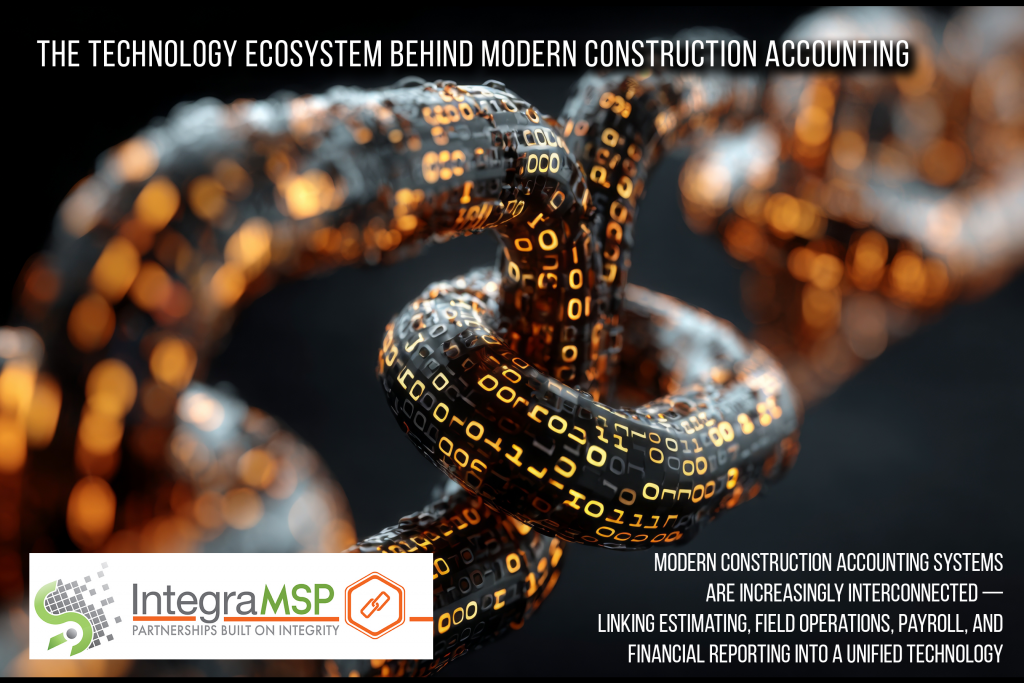
Modern construction accounting environments increasingly resemble technology ecosystems — interconnected systems that share data across estimating, project management, payroll, reporting, and field operations.
And while these ecosystems unlock stronger operational insight, they also introduce a new layer of technological complexity that many construction companies are only beginning to navigate.
Construction accounting is no longer just accounting software
For decades, accounting platforms were the center of financial management in construction.
They tracked the general ledger, processed payroll, handled accounts payable, and produced financial statements.
But construction operations generate financial data long before it reaches the accounting system.
- Estimates define the expected cost structure of a project.
- Project management systems track commitments and change orders.
- Field reporting captures daily production data and labor hours.
- Payroll systems allocate labor across jobs and cost codes.
Each of these systems contributes information that ultimately shapes financial reporting.
As a result, construction accounting today often relies on data flowing between multiple platforms rather than being created entirely within a single system.
When these systems work together well, contractors gain something that was historically difficult to achieve: a more consistent financial view of the business from estimate to project completion.
The rise of integrated construction systems
Many construction firms now operate with a technology stack that includes:
- estimating software
- accounting or ERP platforms
- project management systems
- time tracking and payroll tools
- equipment management platforms
- document management systems
- business intelligence or reporting tools
Each platform serves a specific operational function. But the real value appears when those systems share information. Estimating data can inform project budgets. Field data can validate production assumptions. Payroll hours can automatically feed job cost reporting.
The result is a more complete operational picture — one that helps leadership understand project performance while work is still in progress rather than months after the fact. This is one reason many contractors are pushing toward real-time financial visibility and more advanced reporting structures. But the more systems that become connected, the more important the underlying technology environment becomes.
The technology behind the ecosystem
When construction companies think about accounting technology, they often focus on selecting the right software. But once multiple systems are connected, the conversation quickly expands beyond software alone. The reliability of the entire environment begins to depend on the infrastructure supporting it. Several factors quietly determine whether these connected systems operate smoothly:
Infrastructure performance
Construction accounting platforms often rely on databases that must process large volumes of financial and operational data. If servers, hosting environments, or cloud resources are undersized, system performance can degrade quickly. Slow systems do more than frustrate users. They can delay billing cycles, slow payroll processing, and limit the timeliness of financial reporting.
Network reliability
Field data, remote offices, and distributed project teams place significant demands on network infrastructure. If connectivity between systems becomes unstable, integrations can fail, or data synchronization may lag.
System integrations
Many construction accounting environments rely on integrations to move information between estimating platforms, project management tools, and financial systems. When integrations fail — even temporarily — data inconsistencies can begin to appear across reports and dashboards.
Security and access control
Construction financial systems contain sensitive information, including payroll records, vendor payments, and project financials. As more systems become connected, protecting that data requires careful management of permissions, authentication, and endpoint security. In other words, the accounting ecosystem only works if the technology supporting it remains stable, secure, and well-maintained.
When ecosystems become fragile
Construction companies often arrive at these ecosystems gradually. A new estimating tool is implemented. A project management system is added later. Field reporting software is introduced to improve jobsite visibility. Each addition solves a specific operational problem. But over time, these layers of technology can become difficult to manage if the underlying architecture was never designed to support them.
We frequently see environments where:
- integrations run quietly without monitoring
- Server resources have not been evaluated in years
- Remote access performance limits field adoption
- Security policies vary between systems
None of these issues are immediately visible.
But together, they can erode the reliability of the entire ecosystem.
When that happens, contractors may begin experiencing slow reporting, inconsistent financial data, and difficulty scaling systems as the company grows.
A new role for IT in construction finance
As construction accounting becomes more interconnected, technology support begins to play a larger role in maintaining financial operations. IT is no longer only responsible for keeping servers running or troubleshooting user devices. In many firms, the IT environment now directly influences how well financial systems communicate with one another and how reliably financial data flows through the organization.
That means maintaining construction accounting systems increasingly involves:
- ensuring infrastructure can support modern applications
- monitoring integrations between financial systems
- protecting sensitive financial data
- maintaining performance across distributed offices and jobsites
The accounting ecosystem depends on the stability of the technology behind it.
Where construction firms are heading
The shift toward connected systems is unlikely to slow. Contractors continue to adopt new tools designed to improve estimating accuracy, field reporting, project management, and financial analysis. Each of these tools expands the ecosystem.
For many firms, the next stage of maturity is not simply adopting additional software — it is ensuring the technology environment supporting those systems can scale alongside them.
When the infrastructure is well-designed, these ecosystems can deliver stronger insights into project performance and company profitability.
When it is not, even good software platforms may struggle to reach their full potential. And as construction accounting continues evolving toward real-time reporting and deeper operational visibility, the technology supporting those systems will only become more important.
Give us a call to see if your environment is ready to embrace more cohesive construction accounting.