
By: Jennifer Gilligan, IntegraMSP President
TLDR: OpenAI shut down its Sora consumer app yesterday after high operating costs and declining usage. The decision reflects a broader shift away from consumer-facing creative tools and toward enterprise applications, automation, and systems designed to deliver measurable business value. It also underscores how quickly the AI landscape is changing—and why tool selection now requires more intention.
OpenAI shut down its Sora app yesterday, ending its run as a consumer-facing video generation tool. For many, the timing feels abrupt. Sora videos were still circulating—on LinkedIn, in group chats, in quick demos between colleagues. It was visible, widely tested, and, for a moment, felt like a glimpse of what was next. And now, it is gone.
The reason is less surprising. Estimated compute costs reached $1 million per day, while user adoption declined from roughly 1 million at its peak to fewer than 500,000. Revenue did not keep pace. Developers using the Sora API have until Sept. 24 to migrate, but the consumer product has been discontinued. Why are we talking about this now - the technology worked. The business model did not.
A Familiar Pattern, Reappearing
We are looking at this through a broader lens - AI has changed the tech landscape forever- but so did other tech trends. It is always worth taking a look at the past to help put the present and future into a less reactionary and more cautious context.
What we are seeing in AI right now closely resembles the early stages of the dot-com era. Having gone through that period myself, the similarities are not subtle.
At that time, the internet was already understood to be transformative. But the first wave of companies built around it moved faster than the economics supporting them. Many gained attention quickly. Private Equity fueled an explosive growth with many lofty aspirations of greatness. Fewer proved sustainable.
The parallels are difficult to ignore:
- Rapid product launches
- Strong early adoption
- High visibility
- Unclear or evolving monetization models
There was significant fallout during the dot-com crash—but it also created lasting change. The companies that survived were the ones that paired vision with execution.
Sora’s shutdown highlights a broader challenge across advanced systems. High-quality output—especially video—remains expensive to produce at scale. The gap between what users expect and what it costs to deliver continues to shape which tools remain viable.
At the same time, the end of Sora coincides with the conclusion of its Disney licensing agreement. That partnership allowed users to generate content featuring recognizable characters, but it also underscored the limits imposed by intellectual property. Consumer creative tools will continue to operate within those boundaries.
Against that backdrop, OpenAI’s next move is clear. The company is reallocating resources toward enterprise applications, including coding tools and agent-based systems. Focus is shifting from what tools can create to what they can handle. Automation, workflow management, and system orchestration offer clearer return on investment and more predictable revenue models.
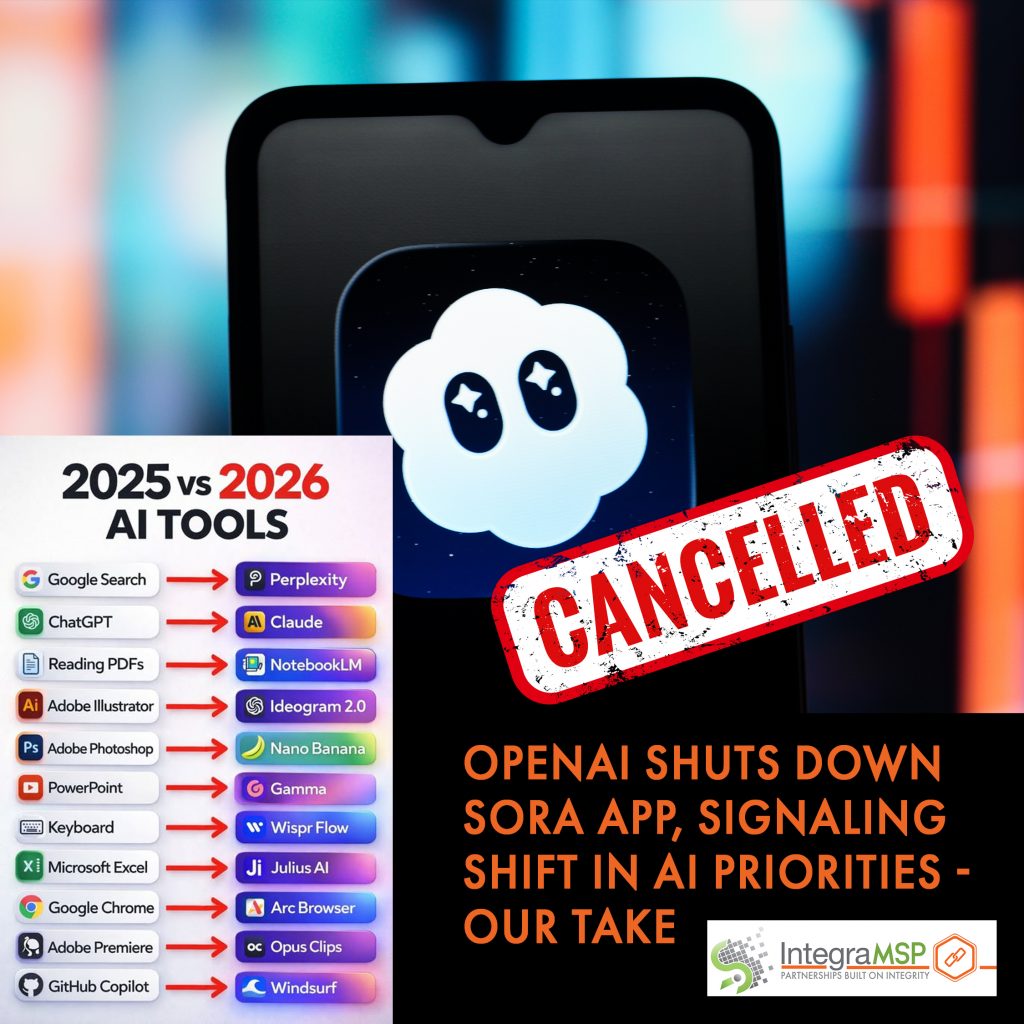
The “2025 vs. 2026” Tool Shift Everyone Is Sharing
A widely circulated “2025 vs. 2026 AI tools” graphic captures this transition in simple terms. On one side are familiar tools—Google Search, ChatGPT, Adobe products, Excel, PowerPoint, Chrome. On the other are newer platforms like Perplexity, Claude, NotebookLM, Gamma, Arc and others that appear to replace them.
It is a clean comparison. It is also incomplete. This is not a one-to-one replacement. It is a consolidation. The newer tools expand their scope. Search becomes search combined with synthesis. Documents become analysis combined with recall. Presentations become creation combined with structure. Coding becomes collaboration combined with execution.
One tool begins to absorb the role of several.
This direction aligns with what Sora’s shutdown reinforces. High-cost, single-purpose tools face increasing pressure; multi-function tools that integrate into workflows—and justify their cost—are gaining ground. At the same time, not all of the tools in that “next” column will last. Some will gain traction and fade just as quickly. Sora is a reminder of how that cycle plays out. Adoption is not durability.
Sora’s exit does not leave the space empty. Competitors, including Runway, Google’s Veo, Kling, and ByteDance, continue to develop video-generation platforms. Each is working through the same challenge—balancing performance, cost, and scale. The next phase of competition will depend less on novelty and more on efficiency.
Taken together, these shifts point to a clear direction. AI capabilities are becoming embedded into existing systems rather than existing as standalone tools. Agent-based systems are expanding, moving from generating output to taking action—routing requests, monitoring environments, and executing multi-step processes. At the same time, tools are consolidating, offering more functionality within a single interface, while cost efficiency becomes central to long-term viability.
Coming Full Circle
The comparison to the dot-com (dot.bomb) era is not exact, but it is useful.
Then, as now, the early wave rewarded speed, visibility, and experimentation. The next phase rewarded durability.
Sora fits squarely into that transition. It demonstrated what was possible; however, it did not prove what was sustainable. That is the shift now underway across the broader AI landscape.
The tools that last will not be the ones that generate the most attention. They will be the ones that:
- Fit into real workflows
- Deliver consistent value
- Operate within sustainable cost structures
The takeaway is not to slow down. It is to be more selective.
Because just like the dot-com era, the technology itself is not in question. What is still being decided is which versions of it will remain.