
By: Jennifer Gilligan, IntegraMSP President
AI is not simply accelerating work. It is accelerating the consequences of operational dysfunction.
Over the past few weeks, much of the conversation around AI governance has focused on compliance, security, insurance exposure, and operational risk. Those concerns are valid, particularly as businesses adopt AI tools faster than governance models can mature alongside them.
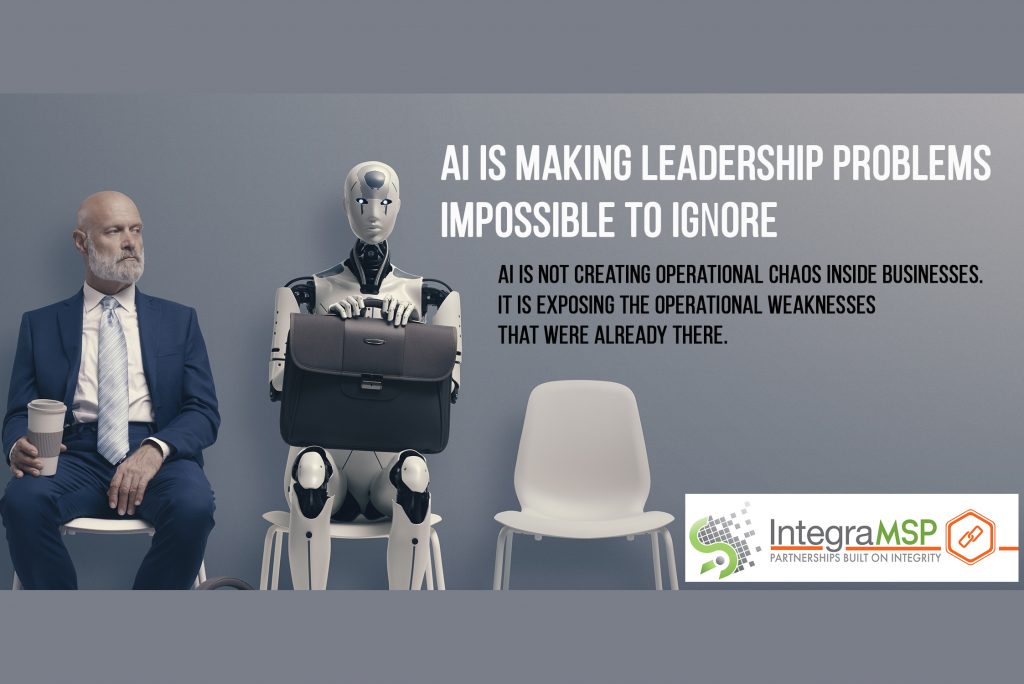
What is becoming increasingly clear, however, is that many of the problems organizations are attributing to AI are not actually AI problems at all. They are leadership, workflow, and operational maturity problems that AI is making impossible to ignore.
A recent essay from David Scott’s AI Answer Engine Playbook framed this challenge particularly well, arguing that while AI reduces workload, it can simultaneously increase operational complexity. That dynamic is already playing out across businesses of every size.
The issue is not that AI creates chaos on its own. In many cases, AI simply exposes weaknesses that organizations were already struggling with:
- unclear ownership
- fragmented workflows
- inconsistent standards
- poor documentation
- disconnected systems
- weak operational accountability
- messy or unreliable data
Two organizations can adopt the exact same AI tools and experience dramatically different outcomes. One company becomes more responsive, more efficient, and more scalable. Another becomes faster at creating confusion.
The difference is rarely the AI itself. The difference is the operating discipline of the organization using it.
This is where the leadership conversation around AI begins to change. For years, operational bottlenecks were relatively visible. Drafting proposals took time. Reporting took time. Research took time. Customer follow-up took time. Delays were obvious because the creation process itself was slow. AI changes the shape of that bottleneck. Now the draft appears instantly, and the meeting summary is ready before the meeting fully settles. The analysis arrives faster than leaders can validate the assumptions behind it; concurrently, teams generate more content, more reports, more dashboards, and more recommendations than ever before.
That sounds productive on the surface.
But in practice, the burden increasingly shifts away from creation and toward:
- interpretation
- prioritization
- governance
- workflow design
- review
- decision-making
- accountability
Those are all leadership functions, not software functions. This is one reason why AI governance is becoming far more operational than many businesses expected. Governance is no longer limited to writing acceptable use policies or deciding which AI platforms employees can access. It now includes determining:
- who owns outcomes
- what standards define quality
- where human oversight is required
- which workflows are approved
- how AI-generated outputs are reviewed
- and whether the organization can absorb increased speed without losing operational clarity
Those questions quickly reveal whether a company has mature systems behind its technology. Recent Gartner reporting reinforces this trend. Analysts continue warning that organizations are mistaking AI enablement for AI readiness, while struggling with governance, operational visibility, and workforce maturity as AI adoption accelerates. At the same time, businesses are entering an era of what many leaders now describe as “AI sprawl,” where teams independently adopt AI tools, workflows, and automations without centralized oversight. The Wall Street Journal recently reported that organizations are increasingly struggling with “AI agent sprawl” as employees rapidly create independent AI-driven processes faster than governance controls can keep pace.
That creates a dangerous form of operational drift. At first, nothing appears broken; productivity increases, and teams feel momentum. Work moves faster.
Then inconsistencies begin to surface:
- different teams using conflicting workflows
- duplicated processes
- inconsistent client communication
- unreliable reporting
- undocumented automations
- AI-generated outputs being trusted without sufficient review
None of those are technology failures; they are operational failures amplified by speed. This is why businesses should resist the temptation to approach AI adoption primarily as a tooling exercise. Buying AI software is the easy part.
The harder challenge is building an organization capable of governing accelerated workflows without sacrificing quality, accountability, and operational consistency. That requires leadership discipline.
Businesses do not need massive governance committees or overly bureaucratic AI programs to move forward responsibly. In many cases, practical operational maturity matters far more:
- defining ownership
- standardizing workflows
- improving documentation
- establishing review processes
- clarifying accountability
- identifying approved tools
- and ensuring AI supports the business instead of fragmenting it
The companies that succeed with AI are unlikely to be the organizations generating the highest volume of output. They will be the organizations using AI to create cleaner operations, stronger workflows, and more scalable systems. Because ultimately, AI is not making leadership less important. It is making operational leadership impossible to avoid.
Related Resources
- David Scott, AI Reduced Our Team’s Workload — But Increased Operational Complexity
Substack: AI Answer Engine Playbook - Gartner research on AI readiness and workforce maturity
- Wall Street Journal reporting on AI agent sprawl and governance challenges