
By Jennifer Gilligan, IntegraMSP President
Insurance companies are sending businesses an early warning about artificial intelligence—and most organizations aren't paying attention.
When insurers encounter a risk they cannot accurately quantify, they don't simply hope for the best. They adjust premiums, narrow coverage, or exclude the risk entirely until they have enough data to understand it. It is a pattern we've seen for decades, and it is beginning to play out with artificial intelligence.
Over the past few months, the signals have become difficult to ignore. AI-related litigation continues to rise. Cyber insurers are introducing AI-specific underwriting requirements and exclusions. Businesses are being asked to disclose how AI is being used, what controls are in place, and who is accountable for its oversight. At the same time, researchers continue to uncover significant security vulnerabilities in AI-generated code, highlighting the risks of rapid adoption without corresponding governance.
Viewed independently, these are news stories. Viewed together, they represent a market shift.
For the past two years, the business conversation has centered on AI's potential. How can it improve productivity? Where can it reduce costs? Which platform should we adopt? Those questions are still important, but they are no longer the only ones that matter.
The next question is far more consequential: Can your organization prove it is using AI responsibly? That distinction changes everything.
Insurers, regulators, customers, and boards of directors are not evaluating AI the same way technology vendors are. They are less interested in which large language model your organization selected than in whether appropriate safeguards exist around its use. They want to know where AI is being used, what data it can access, who approved it, how decisions are reviewed, and whether governance extends beyond a policy document stored in a shared drive. This is where many organizations are exposed.
For many businesses, AI adoption has happened organically. Employees experiment with public AI tools. Departments purchase subscriptions independently. Internal applications are generated with AI-assisted coding. Productivity improves, but visibility often declines. Leadership may have an AI policy, yet lack a complete inventory of the tools employees are using or the data being shared. That creates more than a technology problem. It creates a business risk problem.
Cybersecurity followed a similar path. What began as a technical discipline eventually became a boardroom issue shaped by regulation, customer expectations, legal liability, and insurance requirements. Artificial intelligence is following that same trajectory, only much, much faster.
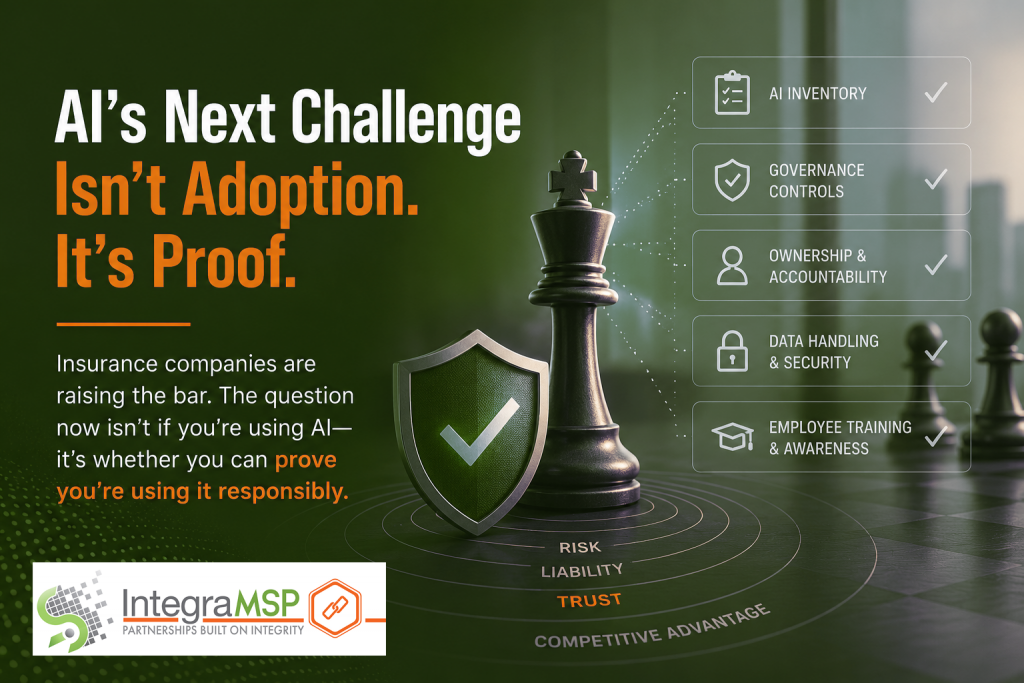
The good news is that businesses do not need to reinvent the wheel. Responsible AI governance is built on disciplines that already exist: inventorying technology assets, classifying sensitive data, establishing clear ownership, documenting policies, training employees, and validating that controls are actually being followed. Organizations that have invested in governance and cybersecurity maturity already have a strong foundation. They simply need to extend those practices to AI.
The goal is no longer to say your organization uses AI responsibly. The goal is to prove it.
That proof may soon determine more than an insurance premium. It may influence contract negotiations, regulatory inquiries, customer due diligence, and ultimately the level of trust your organization earns in the marketplace.
The businesses that thrive over the next decade will not necessarily be those that adopted AI first. They will be the ones who earned the trust to use it responsibly.