
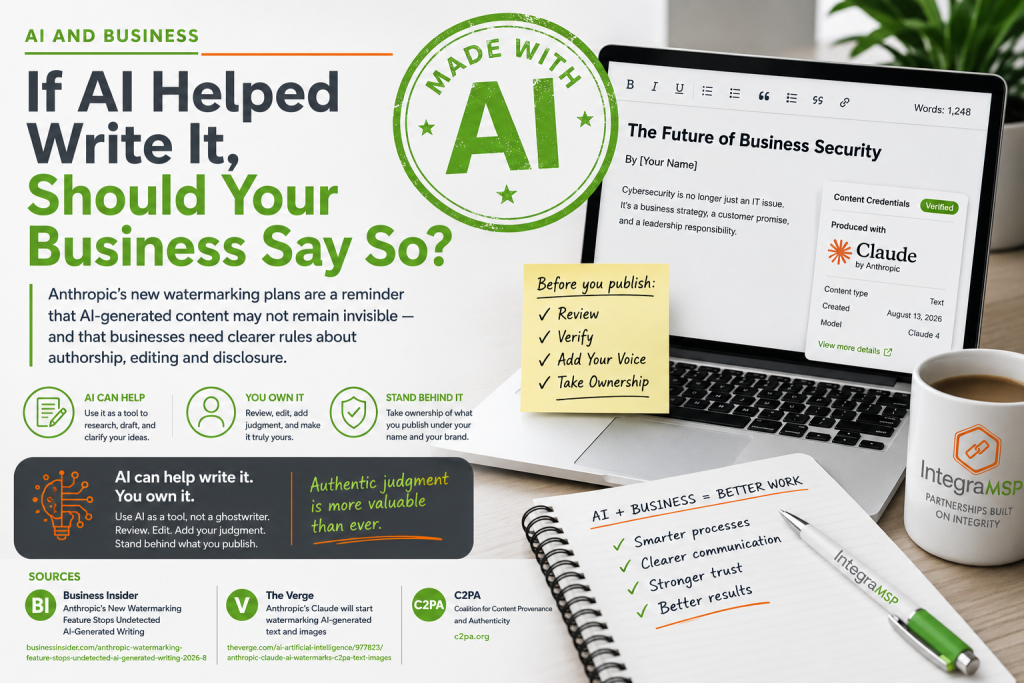
Anthropic’s new watermarking plans are a reminder that AI-generated content may not remain invisible — and businesses need clearer rules about authorship, editing and disclosure.
By Jennifer Gilligan, IntegraMSP President
Businesses are already using artificial intelligence to help create blog posts, emails, proposals, social media content, job descriptions, internal communications, marketing copy and even executive thought leadership.
Until now, most of the conversation about using AI for business writing has focused on quality and security. Is the information accurate? Does it sound like us? Did someone review it? Are employees putting sensitive information into an AI platform they shouldn't be using?
Two stories this week add another consideration to that list: What happens when AI-assisted writing becomes traceable?
Anthropic, the company behind Claude, is introducing technology designed to embed an imperceptible watermark into text generated by its newer models. According to reporting from Business Insider, the watermark does not visibly alter the text, but it can remain when content is copied and pasted and may survive some editing. Anthropic also plans to make detection tools available to third parties.
This doesn't mean a Claude-generated email is suddenly going to arrive with a flashing “written by AI” warning attached to it. The technology has limitations, and there are important nuances about what a watermark can and cannot prove. But it does challenge an assumption many people have made since generative AI became mainstream: that once AI-generated text is copied out of a chatbot, its origin is essentially invisible.
Should businesses disclose AI-assisted content? There isn't one disclosure rule that applies to every use of AI in business writing. A better standard is proportional accountability: The more consequential the content — and the more directly it is attributed to a person — the greater the need for meaningful human review, verification, ownership and, when appropriate, disclosure.
For businesses already publishing AI-assisted content, that is worth paying attention to.
This isn't really about catching people using AI
Business Insider's coverage understandably looks at what watermarking could mean in situations where someone is attempting to pass AI-generated writing off as entirely human-created, including schoolwork and books.
The business implications are more complicated because companies have always had multiple people involved in creating content. Marketing teams write executive bylines. Communications departments polish speeches. Editors substantially reshape rough drafts. Agencies create content on behalf of clients. Generative AI didn't invent ghostwriting or collaborative authorship; it added another participant to a process that was already difficult to define.
Consider an executive who gives a marketing employee several ideas and asks that person to develop them into an article. Most of us would recognize the finished piece as collaborative work. If that executive gives the same ideas to Claude, receives a draft and substantially rewrites it, the distinction becomes less obvious. It gets murkier still if AI is used only for proofreading, restructuring or research.
The relevant question isn't simply whether AI touched the content. It's how much of the thinking behind the finished product actually belongs to the person or company whose name is on it.
Anthropic's watermark won't necessarily answer that question. Business Insider reports that a detectable watermark would not prove Claude originally authored the material because uses such as proofreading or translation could potentially leave a mark. Extensive editing, paraphrasing, translation, or combining AI-generated text with other material may also make a watermark harder to detect.
So no, this isn't an infallible AI lie detector. A watermark may tell us something about a piece of content's history without telling us precisely how it was created. That distinction becomes important as content provenance technology develops.
From detecting AI to documenting where content came from
The Verge's coverage of Anthropic's announcement points to the larger story. Anthropic is pursuing two approaches to content provenance: watermarking for text generated by supported Claude models and C2PA Content Credentials for images processed through Claude. The company expects the markings to operate at the model level, including when Claude is accessed through services such as AWS, Google Cloud and Microsoft Foundry.
C2PA, the Coalition for Content Provenance and Authenticity, has developed a technical standard that can provide tamper-evident information about the origin and editing history of digital content.
There is an important difference between that approach and the AI detectors many people are familiar with. A detector examines finished content and attempts to determine whether AI probably created it. Provenance technology attempts to preserve information about the content's origin and what happened to it along the way.
Neither approach is perfect. The Verge notes that C2PA metadata can be removed, sometimes inadvertently when content passes through platforms that don't preserve it, and Anthropic acknowledges limitations with text watermarking.
Still, the larger direction is significant. We appear to be moving toward a digital environment in which the origin and history of content may become more transparent, not less.
For businesses, that has implications well beyond the technology itself.
If your company's name is on it, who owns the thinking?
Using AI to help write something isn't inherently deceptive. I use AI, and plenty of business leaders do. It can be extremely useful for research assistance, organizing ideas, testing an argument, finding gaps, improving clarity, or getting past the blank page.
The distinction I think businesses need to make is between using AI as part of the writing process and outsourcing the thinking to it.
If an article carries your name, you should know what it says, agree with its conclusions and be able to defend its claims. More importantly, it should reflect something you actually think rather than a plausible approximation of what an AI system believes someone in your position might say. That was good practice before watermarking existed. Better provenance technology may simply make the distinction more visible. Imagine a prospective client reading an article attributed to your CEO and learning that AI was involved in creating it. Whether that damages credibility probably depends heavily on what “involved” means. If the executive developed the argument, supplied the experience behind it, and used AI to organize or polish the writing, there may be very little to explain. If the executive never saw the article and a chatbot produced the entire piece from a prompt asking it to “write 1,000 words about cybersecurity in the voice of a CEO,” that's a considerably different claim to authorship.
The technology may never be able to explain that distinction perfectly. Your company's own standards should.
AI policies need to address authorship, not just security
Most businesses developing AI policies have appropriately focused first on cybersecurity and data handling. Employees need to know which tools are approved, what information can be shared with them, and where sensitive company or client data cannot go.
Companies creating public-facing content should consider adding authorship and disclosure to that conversation.
This doesn't require another 40-page policy. It requires making some practical decisions about when employees may use AI to create company content, which content requires meaningful human review, when AI-assisted material can appropriately carry an individual's byline, who is responsible for verifying sources and factual claims, and whether there are circumstances where AI assistance should be disclosed.
Those standards don't need to be identical for everything a business produces. An AI-assisted social media caption doesn't carry the same implications as an executive byline. A routine sales email isn't a regulatory filing. A first draft of an internal memo isn't an expert opinion issued to a client.
The higher the stakes — and the more personally the content is attributed to an individual — the stronger the expectation should be for human involvement, verification and ownership.
The objective isn't an AI purity test. Trying to determine whether every sentence was touched by artificial intelligence would be both impractical and largely beside the point. The objective is accountability: Someone inside the organization should understand and stand behind what the organization publishes.
“Human in the loop” needs to mean something
Businesses also need to be careful about relying on the phrase “human in the loop” as though it solves the problem. A person scanning an AI-generated document and clicking approve technically qualifies as human review, but it isn't necessarily meaningful editorial judgment.
For important business content, review should include checking factual claims and sources, confirming that the argument represents the organization's actual position, and making sure the finished piece appropriately reflects the experience and perspective of the person whose name appears on it.
This is where human involvement matters for reasons beyond accuracy. AI can write a competent article about leading a company through a crisis, but it hasn't led your company through one. It can summarize what customers care about, but it hasn't spent years sitting across the table from yours. It can generate leadership advice without ever having to make a difficult decision that affects an employee, a customer, or a family.
Those experiences provide the context that makes good business writing worth reading. AI can help us articulate experience. It shouldn't be used to manufacture it.
“Wait, they can do that?”
When I told my husband and business partner, Dan, about Anthropic's watermarking announcement, his immediate reaction was surprise. He didn't realize AI-generated text could potentially carry an embedded marker.
I suspect he's not alone.
That's one reason this development is worth understanding now. The technology is beginning to move beyond trying to identify AI-generated content after the fact. Companies are experimenting with ways to preserve information about a piece of content's origin from the moment it is created.
Anthropic's system is still developing. Third-party detection tools are not yet broadly available, and the company acknowledges that watermarking has limitations. According to The Verge, new Claude models released following the effective date of European Union transparency requirements are expected to support marking from launch, while Anthropic continues working on existing models.
None of this is a reason for businesses to stop using AI. It is a reason to become more deliberate about how we use it.
Use AI to research and brainstorm. Let it challenge an argument, organize a rough draft, or help make complicated writing clearer. There is enormous value in having a tool that can help us think through and communicate ideas more effectively.
But don't confuse assistance with authorship.
If your name or your company's name goes on the finished product, make sure you understand it, verify it, and stand behind it. If it represents your expertise, make sure the expertise is actually yours.
As AI becomes capable of producing more content on our behalf, human judgment doesn't become less important. It becomes one of the things that distinguishes useful, credible business communication from an endless supply of perfectly adequate words.
And if the technology is also getting better at telling us something about where those words came from, that's probably a good reason to establish those standards now rather than later.
* AI assisted. Human edited. Research verified. Ideas and final approval: Jennifer Gilligan.
Sources and further reading
Business Insider: “Anthropic's New Watermarking Feature Stops Undetected AI-Generated Writing”
https://www.businessinsider.com/anthropic-watermarking-feature-stops-undetected-ai-generated-writing-2026-8
The Verge: “Anthropic's Claude will start watermarking AI-generated text and images”
https://www.theverge.com/ai-artificial-intelligence/977823/anthropic-claude-ai-watermarks-c2pa-text-images
C2PA — Coalition for Content Provenance and Authenticity: Information on the Content Credentials technical standard and content provenance.
https://c2pa.org/