Cloud adoption transformed small businesses, but operational maturity had to catch up. AI is following the same pattern.
By Jennifer Gilligan, President of IntegraMSP | Aug. 17, 2026
TL;DR: The early cloud era proved that transformative technology still needs reliable infrastructure, security controls, backups and continuity planning. AI adoption is moving through the same stage now. The goal is not to avoid AI. It is to prevent useful automation from becoming an invisible single point of failure.
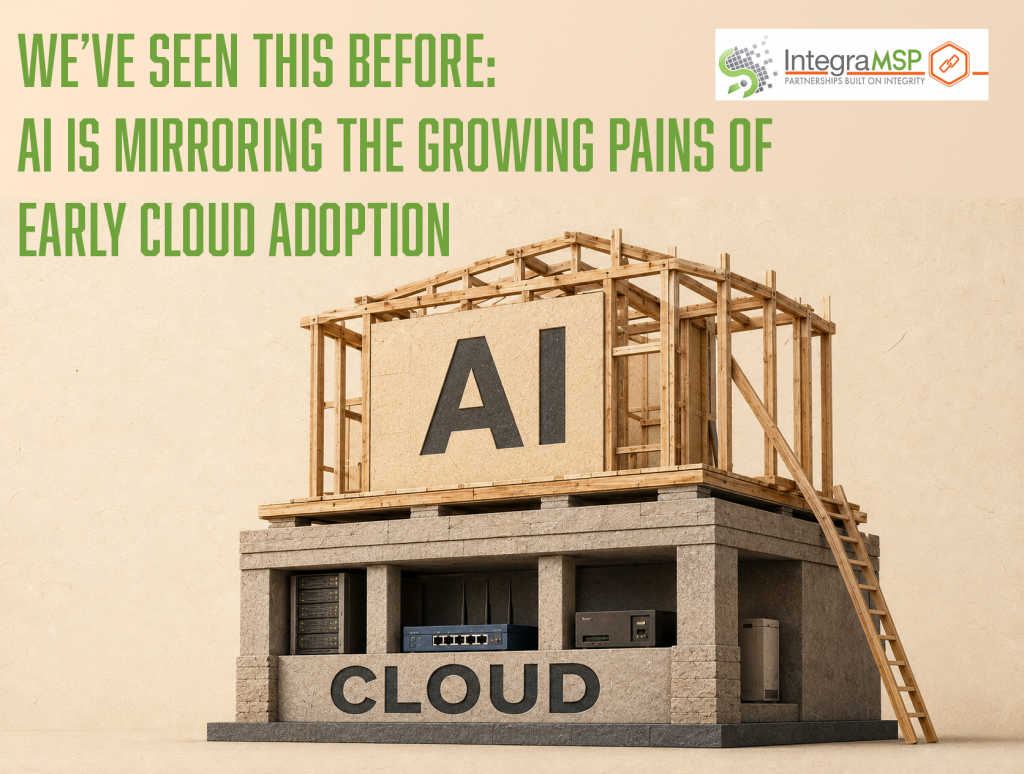
The current rush to adopt artificial intelligence feels familiar to anyone who helped businesses move to the cloud in the early 2010s. The technology was real. The advantages were substantial. Adoption was inevitable. And for a while, businesses moved faster than the infrastructure, security practices, and continuity planning surrounding the technology. AI is now following the same pattern.
The cloud did not eliminate infrastructure
Early cloud computing offered small businesses something extraordinary: enterprise-level applications without an enterprise server room. Companies could reach email, files and software from anywhere, scale without buying racks of hardware and shift major maintenance responsibilities to providers such as Microsoft, Amazon and Google.
Many businesses interpreted that progress as the disappearance of infrastructure. It had not disappeared. It had moved somewhere they could not see it. Local servers were replaced by internet connectivity, identity systems, cloud configurations, vendor contracts and provider availability. Businesses that had moved critical applications online but still relied on one basic internet connection learned that the cloud was technically running while their office remained functionally closed.
Others assumed that storing information in a cloud application meant it was independently backed up. They discovered that synchronization, retention, and recoverable backup were not the same thing. Access from anywhere also created a new identity and security problem: If users could sign in from anywhere, attackers could try the same thing. Cloud adoption was not a mistake. Operational maturity simply had to catch up.
The outages that changed the conversation
A major Amazon Web Services outage in 2011 knocked hundreds of websites offline, including prominent services such as Reddit, Quora and Foursquare. Netflix remained available because its architecture had been designed to expect individual components to fail. WIRED's lesson at the time was blunt: Using the cloud did not automatically create resilience. Customers still had to design for failure.
A year later, Microsoft Azure experienced a prolonged outage linked to a leap-year certificate problem. The incident disrupted core services for more than 12 hours and reinforced an uncomfortable reality: Enormous technology providers could still be taken down by ordinary software and configuration mistakes.
The industry responded over time with better regional redundancy, secondary internet connections, independent backups, stronger identity controls, documented recovery objectives and more serious vendor management. Managed service providers helped translate those practices into something small businesses could actually implement and afford.
The cloud became safer and more dependable not because outages disappeared, but because businesses and providers learned to expect them.
AI is repeating the adoption curve
AI is being sold with another legitimate and transformative promise: Give small teams access to capabilities that previously required more time, more specialists or more money.
A business can use AI to analyze contracts, summarize meetings, generate marketing material, assist developers, triage service requests and answer customer questions. Those gains are real. But AI does not replace the infrastructure lessons businesses learned during the cloud transition. It adds another layer on top of that infrastructure.
The early cloud outages exposed what happened when many seemingly independent services relied on the same data center, region, network connection, or identity system. One failure deep in the technology stack could take down dozens of applications at once. AI creates the same risk—and, in many cases, inherits the cloud risks underneath it.
An AI-enabled workflow may depend on the application employees see, the integration connecting it to company systems, the AI model processing the request, the cloud platform hosting that model, an identity provider and the company’s underlying data. If any one of those layers becomes unavailable, the entire workflow may stop even though the other components are still operating.
This is the modern equivalent of believing that five cloud applications represented five independent systems when all five were running in the same AWS region. Today, five different business tools may appear unrelated while all of them call Claude, another foundation model, or the same cloud platform behind the scenes.
That is the throughline from early cloud adoption to AI: Businesses are once again mistaking multiple applications for multiple independent systems. The interfaces look different, but the infrastructure underneath them may converge at the same failure point.
Because that concentration is largely invisible to customers, vendor questions, dependency mapping and business-impact analysis matter just as much now as redundant internet connections and independent backups did during the early cloud era.
The difference: AI can obscure the human process
There is one important way the AI transition may be more disruptive than the cloud transition.
Cloud computing moved applications and data. AI is beginning to absorb pieces of judgment, communication, and institutional knowledge.
When a cloud file server was unavailable, employees generally still understood what the file contained and what they intended to do with it. When an AI system performs the first analysis, drafts the response, assigns the priority, and recommends the next action, the human process can gradually disappear from view. That creates a different continuity question. It is no longer only, 'Can we reach the system?' It is also, 'Do we still understand the work well enough to operate without it, verify it and take responsibility for the result?'
Human oversight cannot mean clicking approve on an output no one evaluated. It means retaining enough subject-matter understanding to recognize when the AI is wrong, unavailable or operating outside its assigned role.
What small-business AI maturity looks like
Small businesses do not need to recreate the technology architecture of a global bank. They need a practical control framework proportionate to the importance of the workflow.
First, document where AI is being used, including AI embedded inside existing software. Second, identify which workflows can wait, which can continue manually, and which require a technical fallback. Third, keep original data and company knowledge in systems the business controls. Fourth, define approved alternative tools and data-handling rules. Finally, test what happens when the primary provider is unavailable.
That test does not require a three-day disaster simulation. Disable the AI component for an hour and follow a transaction, customer request, or support ticket through the process. Does the work remain visible? Does someone receive an alert? Can an employee take over? Will the system safely resume later without duplicating actions? Those answers reveal far more than a vendor brochure's uptime percentage.
Innovation and resilience belong in the same conversation
The correct lesson from early cloud computing was not that businesses should keep everything on a server in the supply closet. It was that new capabilities need new operating standards.
Cloud maturity gave small businesses better mobility, security, recovery and access to technology that once belonged only to large enterprises. AI can produce a similar expansion of capability. But it will require the same evolution from experimentation to governance, from individual tools to supported systems and from assumed availability to planned resilience.
IntegraMSP's position is not to put the brakes on useful AI. It is to make sure the steering, seat belts and maintenance plan arrive before the business is doing 80 mph.
AI is having its early-cloud moment. New technology often carries familiar risks, and experience helps us see them sooner. Small businesses that recognize the pattern can keep the benefits without relearning every lesson the hard way.
Sources and further reading
Lessons From a Cloud Failure: It's Not Amazon, It's You - WIRED, April 28, 2011.
Half-Day Outage Darkens Microsoft's Azure Cloud - WIRED/Ars Technica, Feb. 29, 2012.
The Long Tail of the AWS Outage - WIRED, Oct. 22, 2025.
Cloudflare resolves outage that impacted thousands, ChatGPT, X and more - The Associated Press, Nov. 18, 2025.
Bank of England handed powers to regulate key tech firms including Amazon and Google - The Guardian, July