Small businesses are relying on AI. The safety net hasn’t caught up. The outage was brief. The dependency it exposed is the bigger business story.
By Jennifer Gilligan, President of IntegraMSP | Aug. 17, 2026
TL;DR: Claude's outage showed that AI is no longer just a convenient writing tool. For many businesses, it has quietly become operational infrastructure. Small businesses should keep adopting AI, but they need to know where it is embedded, preserve company knowledge outside the model, and create practical fallbacks for workflows that affect customers, revenue, security, or compliance.
Claude was unavailable for about 36 minutes Sunday. That is not a catastrophic amount of time. It is barely long enough for someone to restart a laptop twice, blame the Wi-Fi and then discover the problem was not inside the building. But the duration was not the important part. The scope was.
Anthropic reported that the disruption affected Claude.ai, its developer console, the Claude API, Claude Code and Claude Cowork. The incident began with authentication trouble and quickly expanded across nearly every commercial way a business might access Claude.
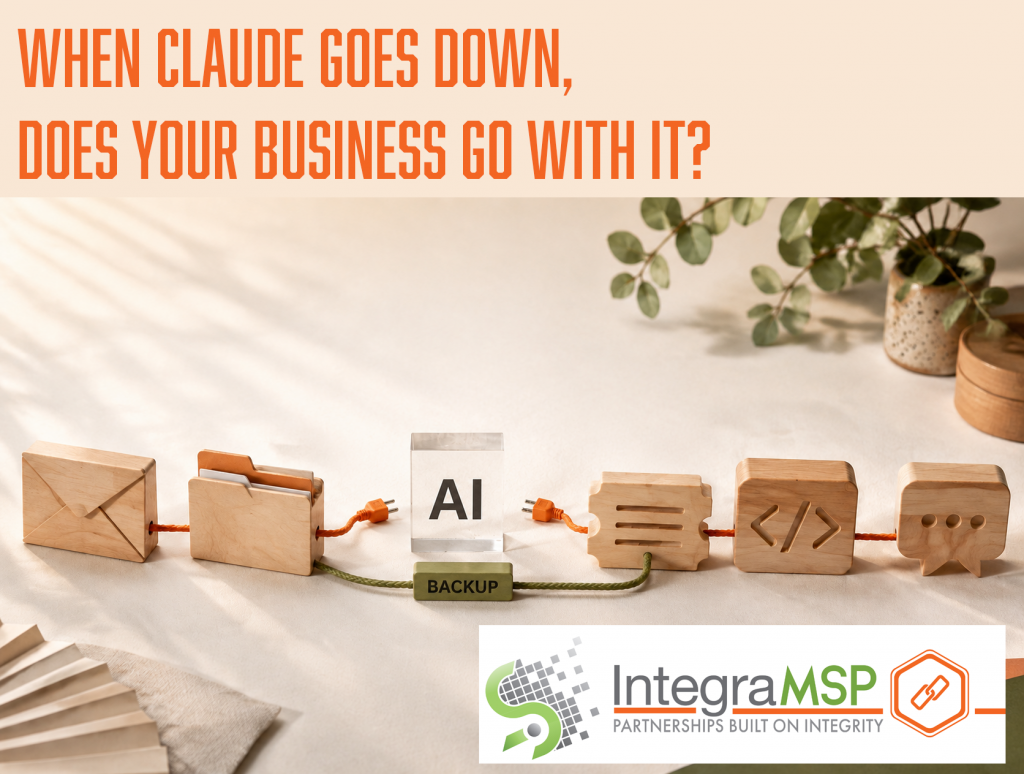
For small businesses, that is the useful warning. AI is moving from optional productivity tool to operational infrastructure, often without anyone formally deciding that it should.
The dependency nobody documented
A company might use Claude directly to draft proposals. Its developers might use Claude Code. Its help desk software might call the Claude API to categorize tickets. A separate application might use the same model to summarize meetings or respond to customers.
From the business owner's perspective, those look like different tools. Operationally, they may share one dependency. That creates concentration risk: several workflows can fail at once because they ultimately rely on the same model provider, cloud platform, identity service, or underlying infrastructure. The dependency is especially difficult to see when Claude is embedded inside another vendor's product.
Moody's recently warned that dependence on a relatively small group of foundation-model and cloud providers could create systemic exposure, with an outage at one major provider spreading across customers and industries. The warning focused on financial institutions, but the mechanism is not exclusive to banks. A 25-person company can become just as dependent on one provider; it simply has fewer people and fewer alternatives available when that provider goes down.
Productivity gains can become productivity debt
Small businesses adopt AI because it helps limited teams accomplish more. That is exactly why an outage can matter.
When AI drafts routine communications, analyzes documents, writes code or triages incoming work, employees gradually reorganize their jobs around it. That is efficient until the business discovers it no longer has a documented manual process, a clean source of truth or anyone prepared to take over temporarily.
IBM reported in June that 91% of 1,000 surveyed executives did not fully understand their organizations' dependencies across AI vendors, models and infrastructure. Seventy-one percent said switching their primary AI vendor or model would be difficult, while 81% said a seven-day vendor outage would cause severe or critical disruption. The research was commissioned by IBM, which has a commercial interest in hybrid and multivendor infrastructure. It should be read with that context. The underlying concern, however, is difficult to dismiss: businesses are integrating AI faster than they are mapping how it affects continuity.
What right-sized AI continuity looks like
Small businesses do not need to build an enterprise-grade command center for every chatbot interruption. They do need to distinguish convenience from dependency.
If Claude helps improve an email, the employee can wait or use another approved tool. If it summarizes a meeting, the recording can be processed later. If it receives customer requests, categorizes security alerts, or updates operational records, the original work must still be captured and routed when the model is unavailable. A resilient AI-enabled workflow should preserve the incoming information, place incomplete work in a queue, prevent duplicate actions when service returns, and escalate time-sensitive items to a person. It should fail in a controlled and visible way, not quietly drop work into a digital abyss.
Businesses also need an approved fallback policy. Telling employees to use another AI tool without defining which tool, which account, and what information may be entered creates a second problem while solving the first. During outages, otherwise sensible people become remarkably creative about pasting company data into whatever website is still responding.
The source of truth should remain yours
Important business information should not live only inside an AI conversation. Procedures belong in the knowledge base. Client information belongs in the CRM or line-of-business system. Tickets belong in the service platform. Code belongs in version control. Decisions belong in approved company records. AI can analyze, summarize, and improve that information. It should not become the sole place the business can retrieve it.
This is also a contractual issue. Anthropic's standard commercial terms state that its services are provided 'as is' and 'as available' and do not promise uninterrupted use. The terms generally exclude consequential losses and cap liability at the amount a customer paid during the previous 12 months. In plain English: the cost of an outage to your business may be far greater than anything the provider owes you for it.
Our position: adopt AI without surrendering control
IntegraMSP is not advising small businesses to retreat from AI. The productivity and competitive advantages are significant, particularly for companies whose employees already wear several hats.
But AI adoption without operational planning creates a new kind of technical debt. The workflow becomes faster while the company becomes more fragile.
The better standard is straightforward: AI should expand a company's capability without becoming an undocumented single point of failure. Know where it is being used. Keep company knowledge in company systems. Decide what happens when the model is unavailable. Preserve human accountability for consequential decisions. Test the fallback before an outage makes the test mandatory.
Claude's outage was brief. The lesson is larger: If an AI provider's bad afternoon can stop an important part of your business, you are no longer managing a clever tool. You are managing infrastructure.
Sources and further reading
Claude Status: Service disruption on Claude services - Anthropic, Aug. 16, 2026.
Anthropic confirms Claude is down in major outage affecting multiple services - BleepingComputer, Aug. 16, 2026.
AI push is putting banks at mercy of tech firms, warns Moody's - The Guardian, Aug. 9, 2026.
Limited Control and Rising Dependencies Leave Enterprises Exposed in the Age of AI - IBM Newsroom, June 17, 2026.
Commercial Terms of Service - Anthropic, effective June 17, 2025.