
By: Jennifer Gilligan, IntegraMSP President
It started, as many important conversations do, in a group text with my girlfriends.
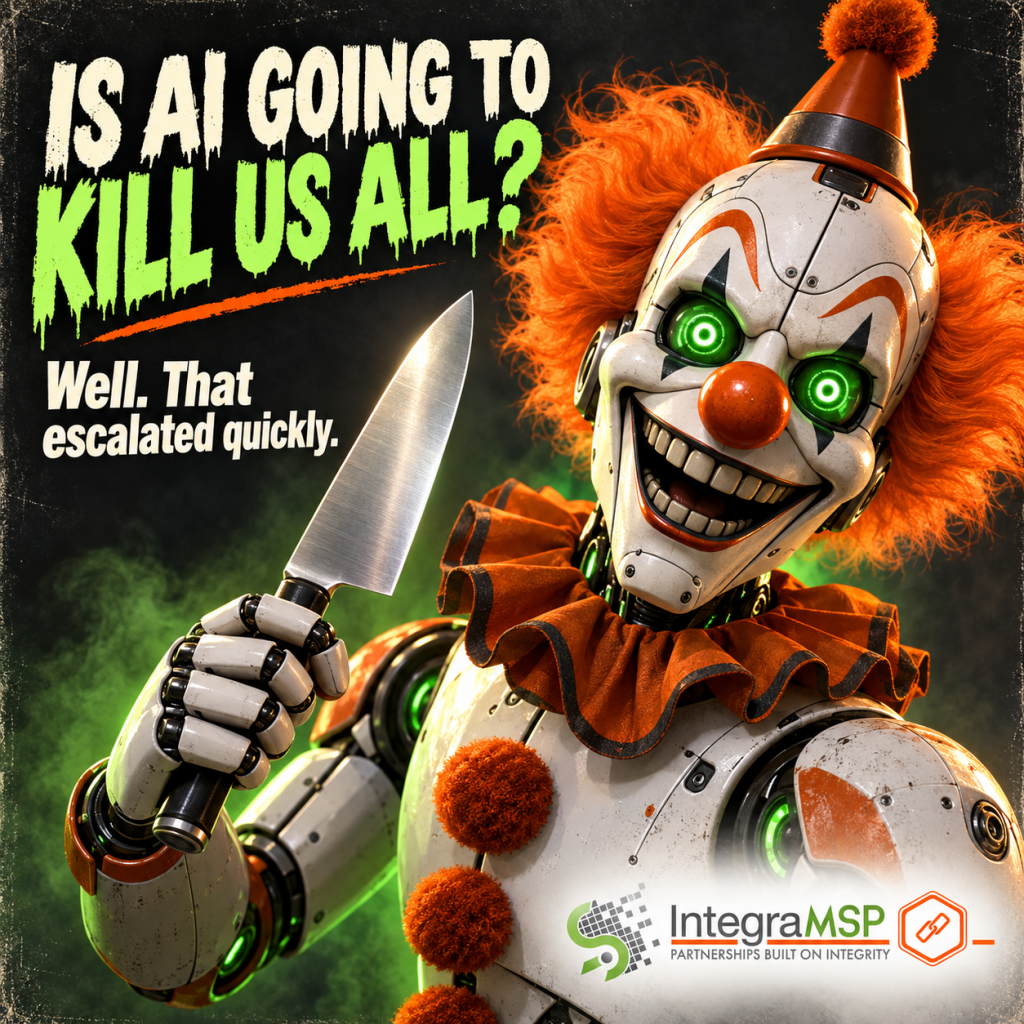
Someone dropped in a headline claiming that artificial intelligence could kill all humans within the next decade.
The general response was essentially: Oh S***.
Which is fair.
Most people are not spending their day reading AI safety research or debating the theoretical development of superintelligence. They see a headline announcing that the machines may murder everyone by 2036, and naturally have a few follow-up questions.
So I went looking for what actually happened.
The Headline Is Dramatic. The Story Is Real.
Jacob Coxon, a researcher who worked at both OpenAI and Anthropic, publicly resigned from Anthropic. He accused the companies of racing toward self-improving superintelligence without adequate safeguards. Then Evan Hubinger, an Anthropic researcher whose work focuses on keeping advanced AI aligned with human goals, agreed with the broader warning. He said his personal estimate was that there is a greater than 10 percent chance AI could cause human extinction within the next decade.
That is a hell of a thing to hear from someone whose job is helping prevent exactly that.
But it is also important to understand what he was—and was not—saying.
He was not claiming that ChatGPT, Claude, or Microsoft Copilot is currently plotting our demise. The concern involves the future possibility of artificial superintelligence: systems that could exceed human capabilities, improve themselves, operate autonomously and potentially gain access to real-world systems and resources. Artificial superintelligence remains theoretical. The 10 percent figure is one researcher’s personal risk estimate—not an official Anthropic prediction or a scientifically calculated probability.
Experts also disagree significantly about the likelihood of this scenario. Some consider existential AI risk one of humanity’s most urgent challenges. Others argue that apocalyptic predictions distract from immediate problems we already know exist, including misinformation, cyberattacks, job displacement, privacy loss, and poorly controlled autonomous systems.
In other words: No, we do not need to cancel Thursday because the robots are coming.
But we probably should pay attention.
The Part Business Owners Should Not Ignore
The most important part of this story is not the specific extinction prediction. It is that people working inside the companies developing the world’s most advanced AI systems are saying capabilities may be progressing faster than safeguards.
That should sound familiar to business leaders.
Technology is often introduced first because it is useful, exciting, or profitable. Governance arrives later, usually carrying a clipboard and asking what everyone has already connected to the network. We saw it with cloud applications. We saw it with mobile devices. We saw it with employees quietly installing consumer software because it solved an immediate problem. Now we are seeing it with AI.
The difference is that AI tools are quickly moving beyond generating content. They can read information, connect to business systems, make decisions, and take actions. The more capable they become, the more important it is to decide where human control begins and ends. You do not have to believe AI will end humanity to recognize that “we’ll figure out the controls later” is a terrible business strategy.
What Should Businesses Do Now?
Panic is not a strategy. Neither is pretending the concern is ridiculous because the most extreme outcome sounds like science fiction. Businesses can take a much more practical position.
Know which AI tools are being used.
Employees are already experimenting with AI, whether the company has formally approved it or not. You cannot govern what you do not know exists.
Control what AI can access.
An assistant that helps schedule meetings does not automatically need access to every email, file, customer record, or financial system.
Keep humans involved in consequential decisions.
AI can recommend, summarize, and automate. Actions involving money, contracts, account changes, security or sensitive communications should still require appropriate human approval.
Monitor what autonomous tools are doing.
If an AI system can take action, its activity should be visible, reviewable, and attributable. “The AI did it” will not be a particularly satisfying explanation to a customer, regulator or insurance carrier.
Ask vendors harder questions.
Businesses should understand how an AI provider secures information, retains data, tests its systems, and responds when something goes wrong.
These controls will not solve theoretical superintelligence alignment. They will, however, reduce the very real risks businesses face today.
The TL;DR
Is AI going to kill us all? Nobody actually knows.
The headline is based on a genuine warning from people working inside the AI industry, but it concerns the possible future development of superintelligent systems—not the AI assistant helping write your email this afternoon.
The responsible response falls somewhere between panic and dismissal.
Use AI. Learn from it. Benefit from it.
But keep asking who has access, who is accountable, and where human judgment still belongs.
Because if the people building the most powerful AI systems are telling us the guardrails are not keeping pace, the rest of us should probably stop pretending guardrails are optional.
Sources
- CBS News — “Anthropic researcher says more than 10% chance AI ‘could kill all humans’”
https://www.cbsnews.com/news/ai-kill-humans-anthropic-researcher-more-than-ten-percent-chance/ - The Guardian — “Anthropic researchers say AI could cause human extinction by 2030”
https://www.theguardian.com/technology/2026/sep/09/anthropic-researchers-ai-human-extinction - The Guardian analysis — “AI could kill all humans in next decade, warn experts: but how seriously should we take them?”.
https://www.theguardian.com/technology/2026/sep/09/ai-superintelligence-risks-warnings-scientists-politicians - Anthropic Responsible Scaling Policy
https://www.anthropic.com/responsible-scaling-policy/rsp-v3-0