By: Jennifer Gilligan, IntegraMSP President
Artificial intelligence is creating opportunities for businesses to automate work, increase productivity, and operate more efficiently. The pressure to adopt is growing, and the potential benefits are difficult to ignore. But amid the enthusiasm, an important question isn't getting enough attention. Who is responsible for managing AI after it's deployed?
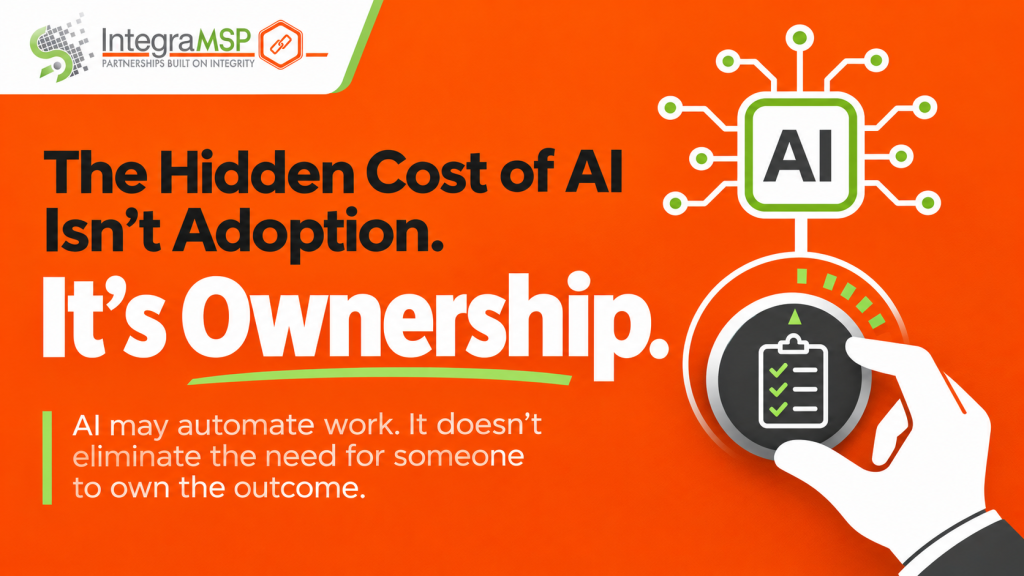
Consider a business that uses AI agents to automate work previously performed by an employee. The projected savings may be compelling. The business gains capacity without adding traditional headcount. But those agents still need oversight. Someone must ensure they have appropriate access to information, perform their assigned functions correctly, and continue operating as business needs change. Someone must monitor security, manage integrations, address failures, and recognize when human intervention is necessary. Automation may reduce the amount of human labor required to perform certain tasks. It doesn't eliminate the need for human accountability. And that oversight has a cost.
Deployment Is Only the Beginning
Much of the current AI conversation focuses on implementation and productivity gains. Far less attention is given to what happens six months or a year later. Technology changes. Integrations break. Permissions need updating. Employees need training. Automated workflows require monitoring, and business requirements evolve. These are ongoing operational responsibilities, not one-time implementation tasks. Businesses need to understand who owns those responsibilities before deploying AI solutions. The same applies to their technology partners. Small and midsize businesses often depend on managed service providers (MSPs) for technical expertise, security, and ongoing support. But implementing an AI solution doesn't automatically mean an MSP has the resources, expertise, or contractual obligation to manage every aspect of it indefinitely. An implementation project is not the same as an ongoing managed service. That distinction needs to be reflected in service agreements, staffing, pricing, and expectations. Otherwise, businesses and their technology partners risk creating responsibilities neither has adequately planned or budgeted for.
The Connection to Cybersecurity and Insurance
We've already seen how unclear responsibilities create problems in cybersecurity. Businesses sometimes purchase security solutions and assume their technology providers are managing the associated risks. Yet cybersecurity requires more than having the right products. It requires ongoing oversight, documented controls, and clearly assigned accountability. Cyber insurance applications and contractual obligations can expose those gaps when organizations are asked to demonstrate how their security practices actually operate. AI introduces additional complexity into an already challenging environment. An AI system may access sensitive information, interact with business applications, or perform automated actions with operational consequences. Those capabilities require appropriate controls and oversight. They also require an understanding of where responsibility begins and ends for the business, its technology providers and the vendors supplying the underlying systems. Purchasing a solution doesn't automatically transfer accountability for how it's used.
The Business Model Has to Catch Up
None of this means businesses should slow innovation simply because every question hasn't been answered. But responsible adoption requires a realistic understanding of the entire lifecycle of the technology. For businesses, that means evaluating the ongoing costs of security, maintenance, employee adoption, and supervision alongside projected productivity gains. There's also the cost of operating AI itself.
Consumption-based pricing introduces expenses that may fluctuate with usage, particularly when automated agents perform multiple tasks or interact with several systems. Token consumption, model selection, and inefficient workflows can all affect operating costs. Token optimization, usage monitoring and cost controls therefore become part of the ongoing management equation. Without them, a solution that appears economical at deployment may become considerably more expensive as adoption increases. Not every AI service uses consumption-based pricing, but businesses relying on those that do need to account for variable expenses when calculating return on investment. Managing these costs introduces another important consideration: Who is responsible for monitoring consumption, identifying inefficiencies and ensuring the technology continues delivering value? For businesses and their technology partners, the broader challenge is establishing sustainable operating models with clearly defined responsibilities, appropriate expertise and realistic budgets that account for the ongoing costs of managing AI, not just implementing it.
For technology vendors, it means recognizing that a solution isn't truly scalable simply because it can be deployed repeatedly. The support and management requirements must be scalable, too.
If a business can afford to implement AI but hasn't accounted for the cost of managing it, has it really calculated its return on investment?
That's the conversation we need to have alongside the discussion of AI's potential. The next phase of AI adoption will require more than new tools and impressive demonstrations. It will require sustainable operating models that account for what happens after deployment. Because automation can change who performs the work. It doesn't eliminate the need for someone to own the outcome.