
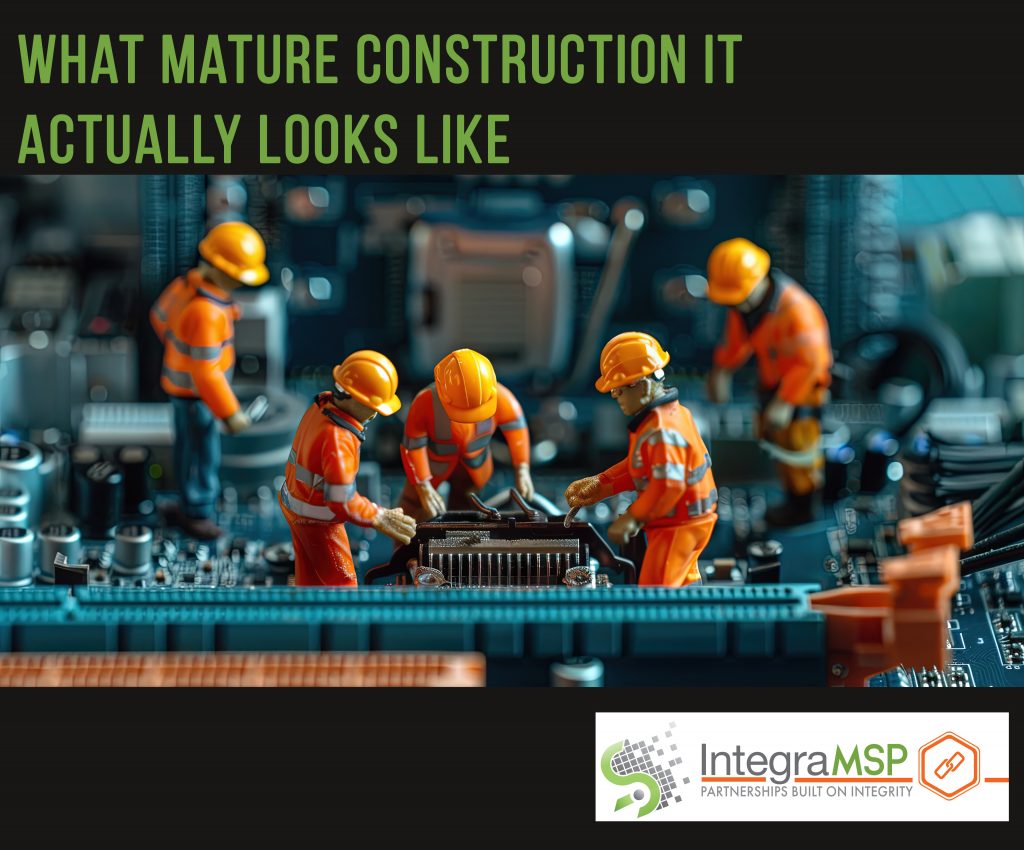
In construction, maturity shows up in systems. You see it in disciplined estimating. In tight project controls. In safety programs that aren’t optional. In financial oversight that doesn’t rely on guesswork.
Technology maturity is no different.
It isn’t about how many platforms you own or whether you’ve migrated to the newest ERP. It’s about whether your environment is architected with intention. Whether your systems support operations without creating friction. Whether your leadership team trusts the numbers without needing to double-check them.
After years working alongside construction firms, one thing becomes clear: most IT stress isn’t caused by bad software. It’s caused by fragile architecture layered together over time.
When construction IT is mature, it doesn’t feel flashy. It feels steady. Predictable. Quietly reliable. And in this industry, steady is profitable.
A mature environment includes cloud-first accounting systems that aren’t dependent on a single physical server in a back office. Financial data lives in secure, redundant infrastructure with documented configurations and recovery plans that have actually been tested. Stability is engineered, not assumed.
It includes secure, monitored payroll integrations. In construction, payroll complexity leaves very little room for error. Mature environments don’t simply “connect” systems — they ensure the infrastructure supporting those integrations is secured, monitored, and documented. Sync services are watched. Scheduled jobs are validated. Failures generate alerts instead of hiding quietly in the background.
It supports real-time job cost visibility that leadership can trust by ensuring the infrastructure and integrations behind the ERP are stable, monitored, and performant. When field data syncs reliably, reporting environments are properly maintained, and access is configured correctly, teams are far less likely to rely on parallel spreadsheets to validate system reports. Reliability builds confidence.
It approaches ERP transitions as operational events, not just technical upgrades. That means infrastructure planning before migration, properly staged environments for testing, controlled cutover support, and post-launch stabilization to ensure performance and continuity. The goal isn’t simply modernization — it’s minimizing operational disruption while new systems come online.
It enforces identity controls that protect financial systems without slowing productivity. Role-based access, multi-factor authentication, and clear permission structures reduce both external threat exposure and internal risk.
And it treats resilience seriously, with disaster recovery that is tested — not theoretical. Backups are restored in controlled exercises. Recovery time is measured. Procedures are documented. When something goes wrong, leadership isn’t guessing what happens next.
Quick Diagnostic: What Does Maturity Look Like in Your Environment?
Consider your current infrastructure:
- Is your accounting system cloud-architected and properly supported, or dependent on aging infrastructure?
- Are payroll and ERP integrations actively monitored — or simply assumed to be syncing correctly?
- Do project managers trust system reporting — or feel the need to rebuild it externally?
- Was your ERP transition supported with structured testing and operational planning?
- Are identity and access controls aligned with financial risk?
- Have you tested full disaster recovery under real conditions?
If several of those are firmly in place, you’re operating with maturity. If not, the gap likely isn’t a software problem.
The software isn’t the problem. Architecture is.
If you’ve already started noticing the quiet friction inside your systems — the workarounds, the validation steps, the hesitation around reporting — that’s often the first signal that architecture needs attention. We wrote recently about where construction IT quietly bleeds money, and how those small inefficiencies compound over time. Maturity is simply the other side of that equation.
The difference between a stable environment and a fragile one is rarely the logo on the login screen. It’s how the entire ecosystem is designed, integrated, secured, and maintained.
When infrastructure is stable, integrations are monitored, ERP workflows are aligned, access is controlled, and disaster recovery is validated, something shifts. Reporting becomes trusted. Decisions accelerate. Margin stabilizes.
Not because of a dramatic transformation, but because nothing is quietly leaking anymore.
If you’re not sure where your environment falls on that spectrum, that’s a conversation worth having. No overhaul assumptions. No dramatic rebuilds. Just a clear look at what’s solid, what’s layered, and where architecture might be quietly working against you.
Sometimes maturity isn’t about adding anything new.
It’s about tightening what’s already there. Book a Discovery Call with us to see where your environment could use a little tightening.