By: Jennifer Gilligan, IntegraMSP President
Construction accounting software often receives the most attention when companies evaluate new technology.
Discussions typically focus on reporting capabilities, job costing features, integration with project management tools or the ability to provide better financial visibility across projects.
But as construction firms adopt more connected systems, another layer of technology becomes increasingly important.
The software itself is only one part of the equation.
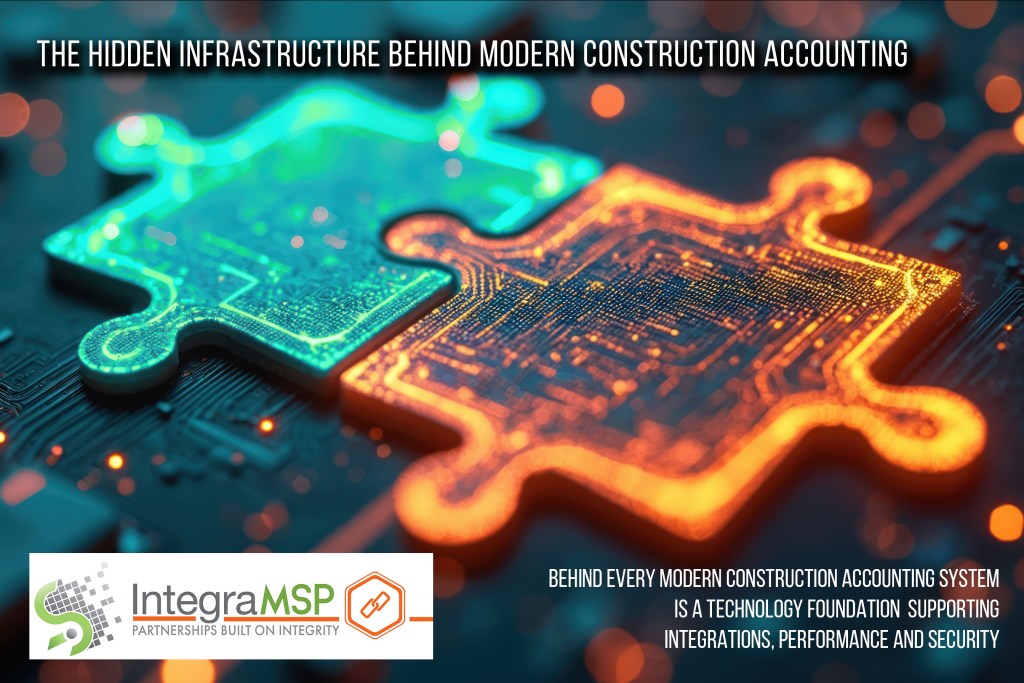
Behind modern construction accounting platforms sits an infrastructure layer responsible for supporting performance, security, integrations and system reliability.
When that infrastructure is designed well, financial systems can operate smoothly and provide the visibility contractors expect. When it is not, even strong software platforms may struggle to deliver their full value.
As construction accounting environments become more interconnected, this underlying technology foundation is becoming a critical part of operational success.
Construction accounting is now part of a larger technology ecosystem
For many years, accounting systems operated somewhat independently within construction organizations. Estimating data might exist in spreadsheets. Project management tools might track schedules and documentation separately. Field reporting often lived in paper logs or standalone applications. Today, that separation is disappearing.
Modern construction firms increasingly operate with connected systems that include:
- estimating platforms
- accounting or ERP systems
- project management tools
- payroll and time tracking systems
- equipment and asset management platforms
- document management environments
- business intelligence and reporting tools
Each of these systems contributes data that ultimately affects financial reporting and project performance analysis. The result is a technology ecosystem where information flows across multiple systems rather than remaining isolated within one application.
While this ecosystem improves visibility and operational insight, it also introduces new technical requirements that many firms did not face when their systems were more independent.
The infrastructure layer most companies rarely see
When contractors implement new software platforms, most of the focus naturally centers on features, usability, and operational improvements. But the performance and reliability of these systems depend on something less visible:
The infrastructure supporting them.
Several core components play a role in maintaining a healthy construction accounting environment.
Infrastructure performance
Construction accounting systems process large volumes of financial and operational data. Job cost transactions, payroll allocations, subcontractor payments, and project reporting all place demands on the underlying database systems. If the infrastructure supporting these systems — whether on-premise servers or cloud environments — is not properly sized, performance can degrade quickly. Slow systems do more than frustrate users. They can delay billing cycles, slow payroll processing and limit how quickly leadership can access accurate financial reports.
Network reliability
Construction firms often operate across multiple offices and active job sites. Employees access accounting systems remotely, field teams submit production data, and project managers review financial performance from different locations. This distributed environment places significant pressure on network infrastructure. If connectivity becomes unreliable, users may experience system slowdowns, failed integrations, or inconsistent access to financial data. Reliable networking is not simply an IT convenience. It is a key factor in ensuring operational systems remain accessible and dependable.
System integrations
Modern construction accounting environments frequently rely on integrations between multiple platforms. Estimating data may flow into project management systems. Payroll information may update job costing automatically. Reporting tools may pull data from several applications simultaneously. These integrations allow systems to work together efficiently. But they also introduce additional complexity. If integrations fail or become inconsistent, financial reports may no longer reflect accurate information across systems. Monitoring these connections and ensuring they continue operating properly becomes an important part of maintaining the overall technology ecosystem.
Security and access control
Construction accounting platforms contain sensitive financial data, including payroll information, vendor payments, and project financial records. As more systems become interconnected and accessible remotely, protecting that information becomes increasingly important.
Security considerations now extend beyond the accounting system itself to include:
- identity and access management
- endpoint security
- remote access controls
- data protection policies
Maintaining consistent security practices across multiple platforms helps ensure financial data remains protected while still allowing employees to access the systems they need.
Why infrastructure problems often appear as software issues
When users experience slow systems or inconsistent reporting, the first instinct is often to blame the software itself. In reality, many of these issues originate from infrastructure limitations rather than application design.
Common challenges may include:
- servers that have not been upgraded as system demands increased
- cloud environments that were not configured for current workloads
- integrations that are no longer monitored or maintained
- network performance limitations affecting remote users
Over time, these issues can create a technology environment where systems appear unreliable even though the underlying software may be functioning correctly. Addressing the infrastructure supporting these systems can often resolve performance and reliability concerns that might otherwise be attributed to the application itself.
The growing role of technology in construction financial operations
As construction accounting environments become more interconnected, technology support plays an increasingly important role in maintaining financial operations.
Reliable infrastructure now supports activities such as:
- billing and accounts receivable processing
- payroll and labor allocation
- job cost reporting
- executive financial visibility
- project performance analysis
When systems operate smoothly, financial teams can focus on analysis and decision-making rather than troubleshooting technical issues. This shift highlights a broader change occurring across the construction industry. Accounting technology is no longer confined to a single department or system. It is part of a larger operational platform connecting finance, project management, and field operations.
Looking ahead
Construction companies continue to adopt new tools designed to improve operational insight and financial visibility.
Each new system contributes valuable capabilities.
But each one also expands the technology ecosystem supporting the organization.
For many firms, the next stage of technology maturity is not simply selecting additional software platforms. It involves ensuring the infrastructure supporting those systems can scale alongside the business. When that foundation is designed well, construction companies can take full advantage of modern accounting tools and connected systems.
When it is not, even strong platforms may struggle to deliver the performance and visibility contractors expect. As construction accounting continues evolving toward real-time reporting and deeper operational insight, the technology behind these systems will play an increasingly important role in supporting the industry. Is your infrastructure ready for these changes? Find out.