By: Jennifer Gilligan, IntegraMSP President
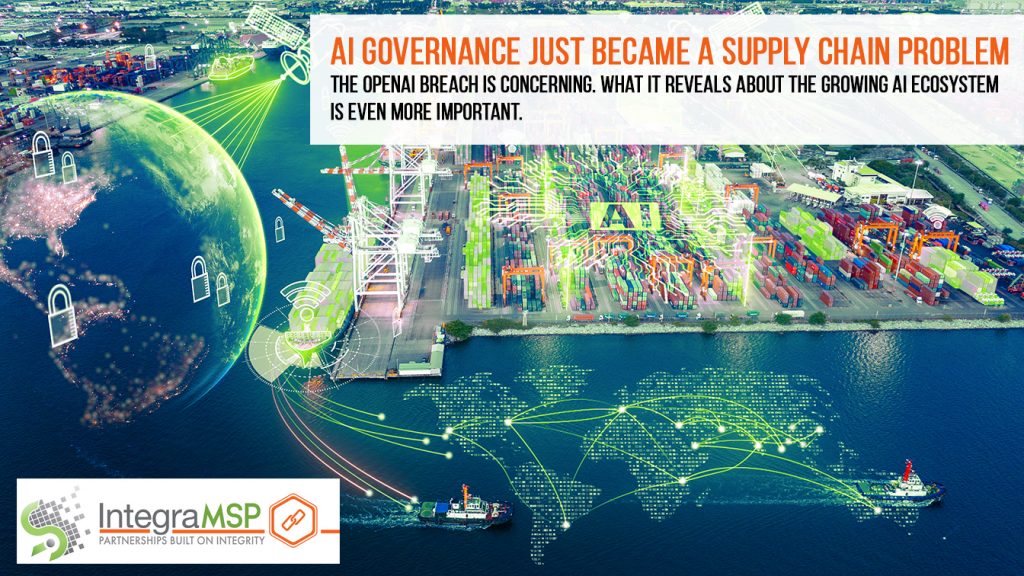
The OpenAI breach is concerning. What it reveals about the growing AI ecosystem is even more important.
For the past several months, businesses have been focused on how to adopt AI faster, integrate it into workflows, and improve productivity across teams. What many organizations have not fully considered is how quickly AI is becoming embedded into the broader software supply chain itself.
That reality came into sharper focus last week after OpenAI confirmed that two employee devices were compromised during the recent TanStack supply chain attack, a widespread campaign that affected hundreds of npm and PyPI packages used throughout the software development ecosystem. According to reporting from BleepingComputer, the attack leveraged compromised development workflows, stolen credentials, and malicious package updates distributed through legitimate software pipelines. The malware also targeted developer credentials, cloud tokens and AI-enabled tooling integrations. (bleepingcomputer.com)
The important takeaway is not simply that OpenAI was impacted.
The larger issue is that AI tooling is now deeply integrated into:
- software development workflows
- browser extensions
- CI/CD pipelines
- cloud infrastructure
- productivity platforms
- automated operational processes
That means AI governance is no longer just a policy conversation. It is becoming an operational security conversation.
A few years ago, businesses faced similar challenges as cloud adoption accelerated faster than governance controls could keep pace. Employees adopted SaaS applications, file-sharing tools, and collaboration platforms long before most organizations developed clear governance strategies around them. The result was shadow IT. Now businesses are entering the era of shadow AI.
Employees and developers are increasingly using:
- AI coding assistants
- browser-based AI tools
- embedded copilots
- AI-enabled plugins
- workflow automations
- public large language models
Often, organizations have limited visibility into:
- which AI tools are being used
- what company data is being entered into those systems
- where AI-generated outputs are influencing business decisions
- or how AI tooling is interacting with existing infrastructure
That creates significant governance and security concerns.
In the TanStack incident, researchers found that attackers leveraged weaknesses in development workflows and CI/CD pipelines to distribute malicious software through trusted package ecosystems. Malware associated with the campaign reportedly targeted GitHub credentials, cloud access tokens, Kubernetes secrets, and even persistence mechanisms tied to AI development environments and coding tools. (socket.dev) This is exactly why businesses should resist the temptation to treat AI adoption as an isolated productivity experiment.
AI is rapidly becoming infrastructure. That changes the conversation considerably.
For many organizations, the greatest AI risk may not be the model itself. It may be the sprawling ecosystem surrounding it:
- integrations
- plugins
- third-party dependencies
- automated workflows
- developer tooling
- unmanaged AI extensions
Those systems create new attack surfaces and operational complexity that many businesses are not yet prepared to govern effectively. The OpenAI incident also reinforces a growing argument around enterprise AI adoption strategy. For most businesses, the safest and most practical path forward is likely not allowing unrestricted use of public AI tools or encouraging employees to piece together disconnected AI ecosystems on their own.
Instead, organizations should focus first on AI capabilities already embedded within trusted enterprise platforms that provide:
- identity management
- audit logging
- tenant protections
- administrative oversight
- vendor accountability
- compliance controls
Enterprise vendors are investing heavily in securing those environments because they understand governance and operational trust will become central to long-term AI adoption. Distinction matters.
There is a significant difference between:
- governed enterprise AI
and - unmanaged public AI usage spread across unknown tools and integrations
This is also where the insurance conversation begins to evolve. As AI becomes more operationally embedded inside businesses, insurers and regulators are unlikely to focus solely on whether organizations use AI. The more important question will become whether businesses can demonstrate reasonable governance and operational control around how AI systems, plugins and workflows are managed.
That likely includes:
- approved AI usage standards
- plugin and extension governance
- credential management
- developer workflow controls
- human oversight requirements
- vendor risk evaluation
- visibility into AI-enabled tooling
Those are operational governance conversations, not hypothetical future concerns. Businesses do not need to panic about AI adoption. Most organizations should absolutely continue exploring how AI can improve productivity, communication, and operational efficiency. However, the OpenAI and TanStack incident is a reminder that AI adoption is maturing quickly, and governance models need to mature alongside it. Because the next phase of AI risk may not come from the AI itself. It may come from the rapidly expanding ecosystem surrounding it.
Related Resources
- OpenAI confirms security breach in TanStack supply chain attack
https://www.bleepingcomputer.com/news/security/openai-confirms-security-breach-in-tanstack-supply-chain-attack/ - Mini Shai-Hulud Hits TanStack npm Packages
https://www.infosecurity-magazine.com/news/mini-shai-hulud-tanstack-npm/ - Previous article in this series:
“Wait… Employees Are Using WHAT?” — The Next AI Insurance Problem
https://www.integramsp.com/2026/05/13/ai_insurance_problem/