
By: Jennifer Gilligan, IntegraMSP President
In May, I wrote an article titled AI Governance Is About to Become an Insurance Problem. The central argument was that AI governance would not ultimately be driven by regulation alone. Instead, the strongest pressures would emerge from insurers, customers, contractual obligations, and the broader realities of business risk.
In the weeks since that article was published, the conversation surrounding artificial intelligence has continued to evolve in precisely that direction. What was initially framed as a discussion about innovation, productivity, and competitive advantage is increasingly becoming a discussion about accountability, governance, and risk management.
The first phase of widespread AI adoption was defined largely by experimentation. Organizations moved quickly to identify use cases, test productivity gains, automate workflows, and demonstrate that they were not falling behind competitors. That urgency was understandable given the pace of technological advancement and the market pressure surrounding AI adoption. However, it also created a predictable gap between deployment and governance.
The industry is now beginning to confront that gap.
Recent reporting and industry research suggest that organizations are deploying AI at a pace that exceeds their ability to govern it effectively. The concerns being raised extend well beyond regulatory compliance and include data governance, model oversight, vendor accountability, intellectual property protection, cybersecurity exposure, auditability, employee usage, and the ability to demonstrate responsible AI practices to customers and insurers.
An IBM study published this month found that 77 percent of technology leaders believe existing AI governance frameworks are inadequate for the level of responsibility organizations are assuming. The research also found that many executives are accountable for AI systems over which they have limited visibility and control, creating a governance challenge that extends beyond technology management and into enterprise risk management.
At the same time, industry analysts and security leaders have increasingly focused on the development of formal AI risk management frameworks. The conversation has expanded beyond implementation strategies and now includes accountability structures, governance controls, audit requirements, vendor management practices, and operational oversight. These developments reflect a growing recognition that AI must be managed as a business system rather than simply deployed as a technology tool.
This broader industry shift was particularly evident during recent conversations at industry conferences and events. One theme appeared repeatedly across discussions with technology leaders, vendors, and service providers: the industry has begun pivoting from building AI to governing AI.
That distinction is significant.
The question is no longer whether artificial intelligence can create efficiencies. In many cases, it clearly can. The more pressing challenge is ensuring that those efficiencies are achieved within a framework that protects organizations from unintended consequences and unmanaged risk. Productivity gains that introduce new liabilities cannot be viewed in isolation from the costs associated with governance, oversight, compliance, and accountability.
This is one reason the recent formation of the Consortium for Responsible IT Services deserves attention. The consortium, which brings together GTIA, Texas A&M University, Pax8, and industry leaders, was established to help develop standards and best practices for responsible technology and AI adoption. For the managed services industry, the initiative represents an acknowledgment that AI governance can no longer remain an abstract policy discussion. It must become operational.
Managed service providers are uniquely positioned to contribute to this effort. For decades, MSPs have helped organizations manage cybersecurity, compliance, business continuity, resilience, vendor risk, and operational governance. The challenges emerging around AI governance are not separate from those disciplines. They represent the next evolution of them.
The insurance implications are also becoming increasingly difficult to ignore. Insurers are unlikely to evaluate AI risk through the lens of technological novelty. They will assess whether organizations maintain documented policies, employee training programs, governance controls, oversight mechanisms, audit trails, and defensible processes. Customers are beginning to ask similar questions through procurement reviews, security assessments, and contractual requirements. Market expectations are evolving faster than regulatory frameworks, creating pressure that organizations must address regardless of future legislation.
The technology industry has spent the past two years racing to build and deploy AI capabilities. The next phase will be defined by the ability to govern those capabilities responsibly, manage associated risks, and demonstrate accountability to stakeholders.
This does not represent a retreat from innovation. Rather, it reflects the natural maturation of a transformative technology. Every major technology shift eventually requires governance structures capable of balancing opportunity with risk. Artificial intelligence is now entering that phase.
The organizations that derive sustainable value from AI will not necessarily be those that adopt it first. They will be those that can clearly explain how AI is used, where risks exist, who is accountable for outcomes, how decisions are monitored, and what controls are in place when failures occur.
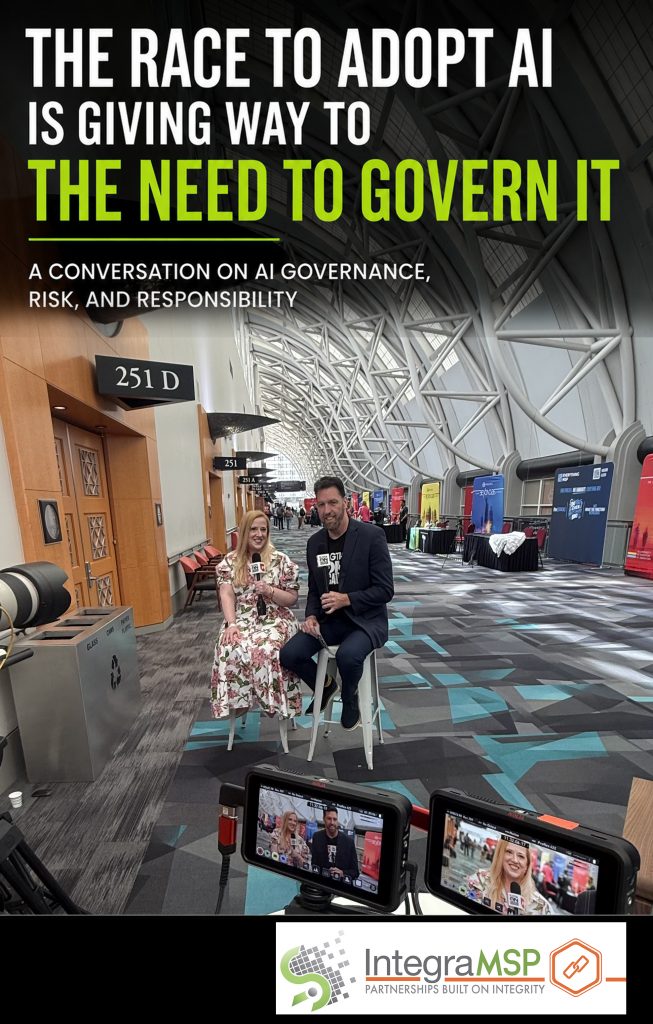
These were themes I explored in my original article, AI Governance Is About to Become an Insurance Problem, and later in my discussion with Scott Campbell on GTIA On Location. In the weeks since those conversations took place, the volume of governance-focused research, industry initiatives, and risk-management discussions has only increased, reinforcing the conclusion that AI governance is rapidly evolving from a compliance consideration into a core business discipline.
The debate surrounding artificial intelligence is no longer centered exclusively on capability. Increasingly, it is centered on responsibility.
Sources and Further Reading
AI Governance Is About to Become an Insurance Problem
Jennifer Gilligan, IntegraMSP
https://www.integramsp.com/2026/05/11/ai-governance-is-about-to-become-an-insurance-problem/
GTIA On Location: AI Governance Discussion with Scott Campbell
https://www.youtube.com/watch?v=e482tZvsSK0
CIOs and CTOs Are Making High-Stakes Decisions With Incomplete Information, IBM Survey Reveals
ITPro, June 2026
https://www.itpro.com/technology/artificial-intelligence/cios-and-ctos-are-making-high-stakes-decisions-with-incomplete-information-ibm-survey-reveals
New IBM Study Finds CIOs and CTOs Face Growing AI Control Gap as Enterprise Deployment Scales
IBM Institute for Business Value, June 2026
https://newsroom.ibm.com/2026-06-08-new-ibm-study-finds-cios-and-ctos-face-growing-ai-control-gap-as-enterprise-deployment-scales
5 AI Risk Management Frameworks for Shoring Up Key Gaps
CSO Online, June 2026
https://www.csoonline.com/article/4185917/5-ai-risk-management-frameworks-for-shoring-up-key-gaps.html