
By: Jennifer Gilligan, IntegraMSP President
The pressure to adopt artificial intelligence has become difficult for business leaders to ignore. Boards are asking about AI strategy. Private equity firms are looking for measurable returns. Vendors promise greater efficiency, lower operating costs and increased productivity. It is easy to understand why many organizations have moved quickly to integrate AI into their operations.
What has been more difficult to measure is whether those investments are delivering the returns many expected.
The conversation surrounding AI has largely focused on adoption. Which tools should we implement? Which processes can we automate? How quickly can we reduce costs? Those are reasonable questions, but they overlook a more fundamental one.
What are we actually trying to optimize?
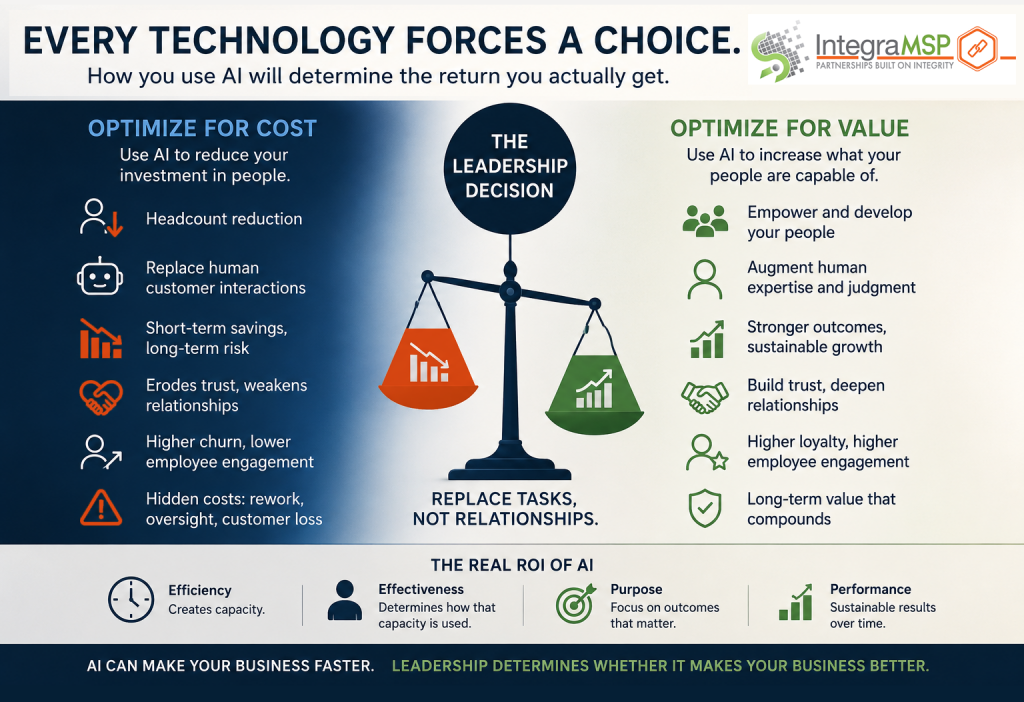
Every significant technological shift presents leaders with a choice. They can use new technology to reduce their investment in people, or they can use it to increase what their people are capable of accomplishing. While both approaches may improve efficiency, they produce very different organizations.
That distinction is becoming increasingly important as businesses move beyond AI experimentation and begin evaluating real-world results.
According to McKinsey's latest State of AI research, AI adoption continues to accelerate across industries, yet relatively few organizations report significant bottom-line improvements directly attributable to their AI initiatives. Deloitte reached a similar conclusion in its AI ROI research, finding that organizations realizing the strongest returns are not simply deploying more AI. They are redesigning business processes, investing in governance and integrating AI into workflows that complement, rather than replace, human expertise.
Those findings suggest that AI alone is not the competitive advantage. Thoughtful implementation is.
That observation becomes even more relevant when organizations begin measuring the full cost of AI deployment. While automation can reduce the time required to complete repetitive work, AI also introduces new responsibilities. Employees must review AI-generated content, validate recommendations, correct inaccuracies, and ensure that outputs meet business, legal, and compliance requirements. CIO recently reported that employees spend an average of more than six hours each week reviewing and correcting AI-generated work, a hidden operational cost that is rarely reflected in early ROI calculations.
None of this suggests AI is failing. Quite the opposite. AI is proving remarkably effective at accelerating routine work and increasing organizational capacity. The challenge is that many organizations are measuring efficiency while overlooking effectiveness.
Efficiency measures how quickly work is completed. Effectiveness measures whether the work creates meaningful value.
Reducing the time required to document a meeting, summarize a report, or organize information creates capacity. The return on that investment is determined by how employees use the time they gain. If that time is reinvested in solving more complex problems, strengthening customer relationships, mentoring colleagues, or identifying new opportunities, AI becomes a force multiplier. If it simply becomes another justification for reducing headcount, organizations may find they have optimized costs while diminishing the very capabilities that differentiate them.
The customer experience tells a similar story.
Recent consumer research has found growing resistance to organizations that rely too heavily on AI for customer interactions. SurveyMonkey reported that nearly 80 percent of consumers still prefer interacting with a human when seeking customer service. Research discussed recently by The Business of Tech also found increasing concern among consumers when AI replaces human interaction without transparency, with trust declining as organizations rely more heavily on automated engagement.
Customers are not rejecting technology. They are questioning whether technology is being deployed in ways that improve their experience or simply reduce operating costs.
That distinction matters.
Using AI to summarize internal meetings, accelerate documentation, analyze large datasets, or automate repetitive administrative tasks removes work that contributes little strategic value. Using AI to replace trusted advisors, experienced account managers, or meaningful customer conversations is a very different proposition. One removes repetitive tasks. The other risks removing the relationship.
History offers plenty of examples of organizations adopting new technologies faster than they develop the discipline to use them well. Cloud computing promised lower costs, yet many organizations ultimately discovered that simply moving everything to the cloud was neither financially nor operationally optimal. Successful cloud strategies emerged only after businesses learned which workloads belonged there and which did not.
AI appears to be following a similar path.
The organizations that ultimately realize the greatest return will likely not be those that automate the most work. They will be those who make better decisions about where automation belongs. They will understand that replacing tasks is fundamentally different from replacing expertise, judgment, and trust.
That philosophy has shaped our own approach at IntegraMSP. We continue to invest in AI because we believe it has tremendous potential to eliminate repetitive work, improve consistency, and help our team move faster. Our objective, however, has never been to replace people. It has been to give our people more time to do the work our clients value most: solving difficult problems, providing thoughtful guidance, building lasting relationships, and serving as trusted advisors.
Technology has always expanded what businesses are capable of achieving. AI is no exception. The organizations that benefit most from it will not be those that ask how many people AI can replace. They will be the ones who ask how much more their people can accomplish when technology handles the work that never required uniquely human capability in the first place.
That may prove to be the most valuable return on investment AI has to offer.
Sources
- McKinsey & Company. The State of AI: How Organizations Are Rewiring to Capture Value. https://www.mckinsey.com/capabilities/quantumblack/our-insights/the-state-of-ai
- Deloitte. The AI ROI Paradox: Rising Investment, Elusive Returns. https://www.deloitte.com/global/en/issues/ai/ai-roi-the-paradox-of-rising-investment-and-elusive-returns.html
- CIO. The Hidden Cost of Enterprise AI: 6.4 Hours a Week Babysitting Bots. https://www.cio.com/article/4183804/the-hidden-cost-of-enterprise-ai-6-4-hours-a-week-babysitting-bots.html
- SurveyMonkey. Customer Service Statistics: Consumers Still Prefer Humans. https://www.surveymonkey.com/curiosity/customer-service-statistics/
- The Business of Tech. MSPs Face New Risk: Customer Loyalty Drops When AI Replaces Human Interaction (Podcast) and related reporting on AI ROI and customer trust. https://businessof.tech/podcast/msps-face-new-risk-customer-loyalty-drops-when-ai-replaces-human-interaction/