
The biggest opportunity with artificial intelligence may not be replacing people or making existing processes faster. It may be giving businesses an opportunity to reconsider how work should be designed in the first place.
By Jennifer Gilligan, IntegraMSP President
There is no shortage of conversation about what artificial intelligence could do to the workforce. Will it eliminate jobs? Replace departments? Allow companies to operate with fewer people? Change which careers remain viable?
Those are legitimate questions, but they tend to begin with an assumption that the workforce we have today, and the way we have organized it, is the fixed point. AI is treated as the variable: What happens when we insert this new technology into the existing organization?
After listening to Nancy Hauge, chief people experience officer at Automation Anywhere, speak at GTIA ChannelCon 2026, I came away with a different way of looking at that equation.
Hauge's perspective on the future of work begins well before AI. Many of the structures businesses still use today — departments, management hierarchies, standardized roles and processes designed around functional expertise — have their roots in the Industrial Age. Technology evolved considerably over the decades that followed, but our basic assumptions about how organizations should operate did not always evolve with it.
Computers arrived, and businesses computerized existing processes. Email replaced memos. Databases replaced filing cabinets. Software replaced paper forms. Cloud platforms moved applications out of the server room and made information available nearly anywhere.
Each generation of technology made us faster and more connected. In many cases, however, we used increasingly sophisticated technology to support an organizational model designed for a very different world.
AI presents an opportunity to reconsider the model itself.
What if we designed the work today?
Hauge, who co-authored the 2026 book The Five-Year Century: Bold Leadership and Accelerated Outcomes in the Age of AI, with Automation Anywhere CEO Mihir Shukla, argues that organizations need to move beyond Industrial Age thinking as they adapt to AI.
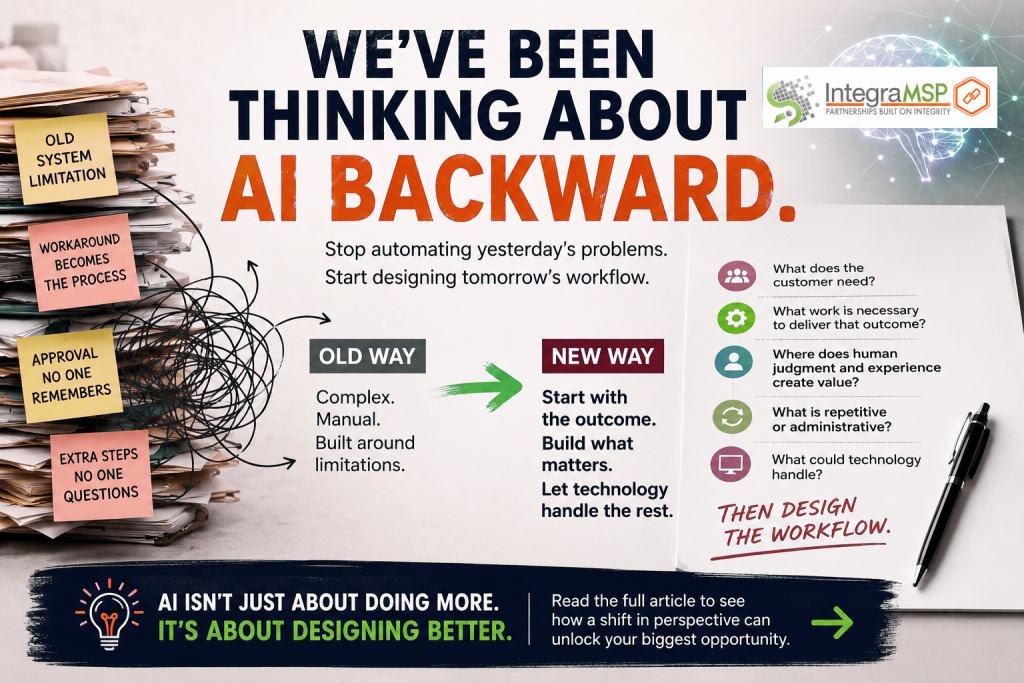
One of the concepts she discussed at ChannelCon was starting with a blank sheet of paper. Rather than looking at an existing process and searching for places to insert AI, businesses can begin with the outcome they are trying to achieve.
What does the customer need? What work is necessary to deliver that outcome? Where is human judgment important? Where does experience matter? Which parts of the process are repetitive or administrative? Which could be handled by technology?
Only then do you design the workflow.
It's a deceptively simple exercise because most organizations don't have the luxury of starting from scratch. Businesses accumulate processes over years, sometimes decades. A procedure may have been created because of a limitation in a system that no longer exists. An approval may remain in place long after anyone remembers why it was required. Employees develop workarounds to compensate for applications that don't communicate with each other, and eventually the workaround simply becomes "the process."
Putting AI on top of all of that may make individual steps faster, but it doesn't necessarily make the underlying process better.
The more interesting opportunity is to examine why those steps exist at all.
Changing the relationship between people and technology
There is another important distinction between AI and many of the technologies businesses have adopted before it.
Historically, people have had to learn how technology works. We learned the software, memorized menus, filled in required fields, navigated databases, and adapted our work to the limitations of the applications we were given.
That created tremendous productivity gains, but it also created work whose primary purpose is servicing technology. Employees enter the same information into multiple systems, search across applications for information, assemble reports from different data sources, and spend time learning where information lives rather than using it.
Generative AI and AI agents begin to change that relationship because people can increasingly interact with technology using natural language and intent. The technology is becoming better at understanding what the person is trying to accomplish instead of requiring the person to understand precisely how the technology works.
That doesn't mean software suddenly understands every business problem, nor does it remove the need for good data, security, governance, or human oversight. It does, however, give businesses an opportunity to decide which parts of a job truly require a person's time and expertise.
Consider an experienced salesperson who spends hours updating systems and preparing reports. A manager may spend a significant portion of the week gathering information before having enough context to make a decision. Someone in finance may spend more time assembling data than analyzing what it means. A longtime employee may possess decades of institutional knowledge but have little time to transfer it because routine responsibilities consume the workday.
We tend to describe each of these as a job. AI makes it useful to look at the individual components inside the job: administration, knowledge, decisions, relationships, judgment, creativity, and problem-solving.
Once the work is viewed that way, the question becomes less about whether AI can perform a person's job and more about which parts of that work should require a person in the first place.
The workforce picture is more complicated than replacement
None of this means AI will leave the labor market untouched. Jobs will change, some roles will disappear, and new ones will emerge.
The World Economic Forum's Future of Jobs Report 2025 estimates that structural changes in the labor market could create 170 million jobs worldwide by 2030 while displacing 92 million, resulting in a net increase of 78 million jobs. The report also estimates that nearly 40% of the skills required on the job will change.
Those figures describe significant disruption, but they don't support the simplest version of the argument that AI will eliminate the need for human workers. They suggest something more complicated: The work itself is changing.
Technical skills in AI, big data and cybersecurity are among those growing in importance, but employers are also placing greater emphasis on creative thinking, resilience, flexibility and agility. As technology becomes better at finding, processing and generating information, the ability to exercise judgment about that information becomes more important.
Knowing an answer and knowing what to do with an answer are different capabilities.
Experience provides context. Judgment helps us recognize when an answer doesn't make sense. Curiosity leads us to ask a better question. Empathy helps us understand how a decision will affect another person. Leadership requires bringing people together around an outcome, particularly when the path forward isn't obvious.
Those capabilities don't disappear because the technology gets better. They become part of the equation businesses need to consider when deciding where people create the most value.
AI is arriving during a capacity problem
The future-of-work discussion is also happening alongside another significant change: workforce demographics.
Hauge raised this during her ChannelCon discussion because the conversation about jobs often focuses on potential displacement without considering the labor and skills shortages many organizations already face.
The World Economic Forum identifies demographic shifts as one of the major forces reshaping the global labor market, alongside technological change. Its 2025 report found that 63% of employers consider skills gaps a major barrier to business transformation.
For many small and midsize businesses, that challenge is already familiar. They are trying to recruit people with specialized skills, retain experienced employees, transfer institutional knowledge before longtime workers retire, and grow without increasing headcount at the same pace as revenue.
They are also trying to prevent talented employees from spending large portions of their day on administrative work that contributes little to the reason they were hired.
In that environment, AI has another potential role. It can add capacity.
A business that automates several hours of routine work hasn't necessarily eliminated a position. It may have created several hours that can be redirected toward customers, analysis, training, innovation, or a backlog of work the organization has never had enough people to address.
What happens with that newly available capacity is a leadership decision.
Before you automate, question the process
There is an understandable temptation for businesses to begin their AI strategy with technology.
Should we deploy Microsoft Copilot? Should employees use ChatGPT? Do we need AI agents? Which applications should we buy?
Those questions eventually need answers, but they shouldn't necessarily be the first questions.
If a business process has 14 steps because three legacy systems don't communicate, adding an AI assistant that helps an employee navigate those 14 steps may improve productivity. It doesn't answer whether the 14-step process should continue to exist.
That distinction matters because automation can preserve bad processes just as easily as it can improve good ones.
A better starting point is the outcome. What is the business trying to accomplish, and if the process were being designed today, would it look anything like the one currently in place?
Sometimes the answer will be yes. Sometimes AI will simply make an existing process faster or easier.
Other times, the exercise may expose organizational habits that have outlived the problems they were created to solve.
That is where AI becomes more than another technology implementation. It becomes a reason to examine how the business operates.
Governance and innovation belong in the same conversation
Rethinking work doesn't mean adopting AI without boundaries.
Businesses have real responsibilities surrounding customer information, intellectual property, cybersecurity, regulatory requirements and the decisions made with AI-generated information. Employees need to understand which tools are approved, what information can be shared with them, when human review is required and who remains accountable for the outcome.
That is sometimes presented as a tension between governance and innovation. In practice, the two can reinforce each other.
Clear guardrails give employees room to experiment because they understand where the boundaries are. Without them, employees may still experiment, but the organization has little visibility into which tools are being used or what company information is being shared with them.
The National Institute of Standards and Technology's AI Risk Management Framework approaches AI governance in much the same way. The voluntary framework is intended to help organizations incorporate trustworthiness into the design, development, use, and evaluation of AI systems rather than treating risk management as something added after deployment.
For business leaders, governance doesn't need to mean creating a committee that spends six months deciding whether anyone can use AI. It means creating enough clarity that the organization can use it deliberately.
This is a leadership discussion, not simply an IT project
Technology teams have an essential role in AI adoption. They understand security, infrastructure, identity, access, data, and the technical ecosystem in which these tools operate.
But they cannot answer every question AI raises for a business, nor should they be expected to.
If AI gives a customer service team back 20% of its time, someone has to decide what the organization wants to accomplish with that capacity. If managers can get business intelligence in minutes instead of waiting days for reports, leadership has to consider how that changes decision-making. If AI can help capture knowledge from a 25-year employee before retirement, the organization has to decide how that knowledge should be preserved and used.
Those aren't primarily technology decisions. They are business decisions enabled by technology.
That's why I think the most productive AI conversations happening right now aren't centered on what a particular product can do. They're centered on what the business is trying to accomplish and what combination of people, process, and technology can accomplish it best.
The organizations that benefit most from AI may not be those that deploy the largest number of tools or automate the greatest number of tasks. They may be the organizations willing to examine assumptions about work that have gone largely unquestioned for decades.
That requires more than an AI strategy. It requires leaders to understand their businesses well enough to distinguish between a process that deserves to be accelerated and one that deserves to be reconsidered.
Hauge's blank-sheet-of-paper exercise offers a useful place to begin. Instead of asking where AI fits into the business you already have, start with the outcome you want to create. Look at the work required to get there. Decide where technology adds leverage and where human experience, judgment, creativity, and relationships matter most.
Then build from there.
AI is going to change how work gets done. Business leaders have an opportunity to influence what that change looks like rather than simply reacting to it.
And if we do this thoughtfully, the measure of success won't be how much work we managed to remove from people. It will be what our people were finally able to do with the time, knowledge, and capacity we gave back to them.