
By: Jennifer Gilligan, IntegraMSP President
Over the last several months, I've probably consumed more information about AI than any reasonably healthy person should. Gartner reports. Vendor surveys. Court rulings. Podcasts. Industry research. Client conversations. Not because I'm trying to become an AI expert, but because I'm trying to answer a much simpler question: What actually matters once all the hype dies down?
What I've found interesting isn't where people disagree. It's where completely different groups are beginning to agree.
Software vendors talk about slowing adoption. CEOs admit their organizations aren't ready. Insurance carriers are asking new questions about AI use. Courts are beginning to hold companies accountable for AI-generated content. Those sound like separate conversations until you step back and look at them together. Then a pattern begins to emerge.
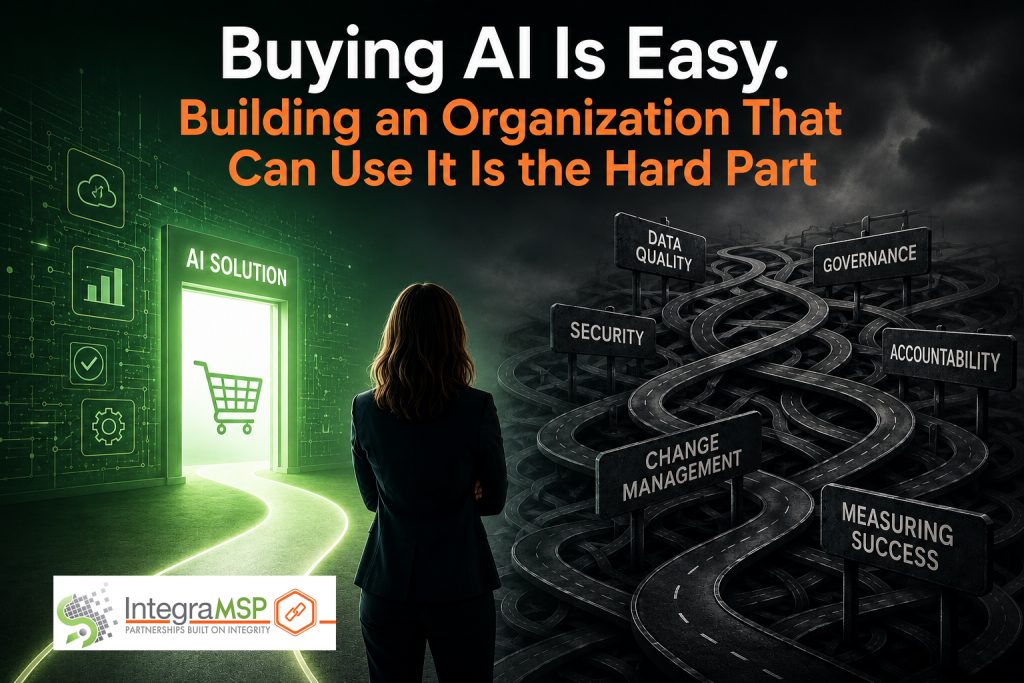
For the past one to two years, we've been focused on the technology. Which model? Which platform? Which features? That made sense when AI was new. Today, I'm not convinced those are the most important questions anymore. AI is becoming easier to buy by the day. The difficult part is figuring out how to integrate it into an organization in a way that creates measurable value without introducing unnecessary risk.
That distinction matters because we've seen this pattern before. Cloud computing wasn't transformative simply because organizations moved workloads into Microsoft 365 or Azure. Cybersecurity didn't improve because someone deployed an endpoint agent. Digital transformation wasn't achieved because a company modernized its software stack. Organizations benefited because they adapted the way they worked. Technology accelerated those decisions, but it didn't make them.
That thought crystallized for me during a podcast on my drive to work this week. The discussion centered on why so many AI proof-of-concept projects never become production deployments. The easy conclusion is that AI isn't delivering on its promise. I don't think that's what the evidence says. Demand for AI continues to grow. Investment continues to increase. Executive attention has never been higher. The technology isn't standing still. If anything, it's improving faster than most organizations can absorb it. The question, then, isn't whether AI works. It's whether organizations are prepared to use it well. That's where I think the conversation around AI begins to shift. Once an AI tool is deployed, the technology has largely done its job. The work that remains belongs to the organization.
- Someone has to determine where AI should and shouldn't be used.
- Someone has to decide which decisions still require human oversight.
- Someone has to establish how success will be measured and who is accountable when the output is wrong.
Those aren't technical decisions. They're business decisions.
This is why I think the conversation around AI is gradually moving away from technology and toward organizational readiness. Every major technology wave eventually reaches this point. Early adopters focus on access. Mature organizations focus on outcomes. AI is beginning to make that transition. That doesn't mean organizations should slow down. Quite the opposite. Businesses need to continue experimenting, learning, and finding practical applications for AI. The goal isn't caution for caution's sake. It's making sure speed doesn't come at the expense of clarity. Organizations that ask better questions early tend to move faster later because they spend less time correcting avoidable mistakes.
That's ultimately the pattern I keep seeing and want to highlight. Software vendors describe an adoption problem. Courts describe an accountability problem. Insurance companies describe a risk problem. Executives describe an operating model problem. I suspect they're all describing different parts of the same underlying challenge. Buying AI is becoming easy.
Building an organization that knows how to use it well is where the real work begins.