By: Jennifer Gilligan, IntegraMSP President
Artificial intelligence is creating tremendous opportunities for small and midsize businesses. It's helping employees work more efficiently, improving customer experiences, and making capabilities that once required significant resources accessible to smaller organizations. That's worth embracing. But there's another part of the AI conversation that business owners need to be paying attention to, and it has less to do with the technology itself.
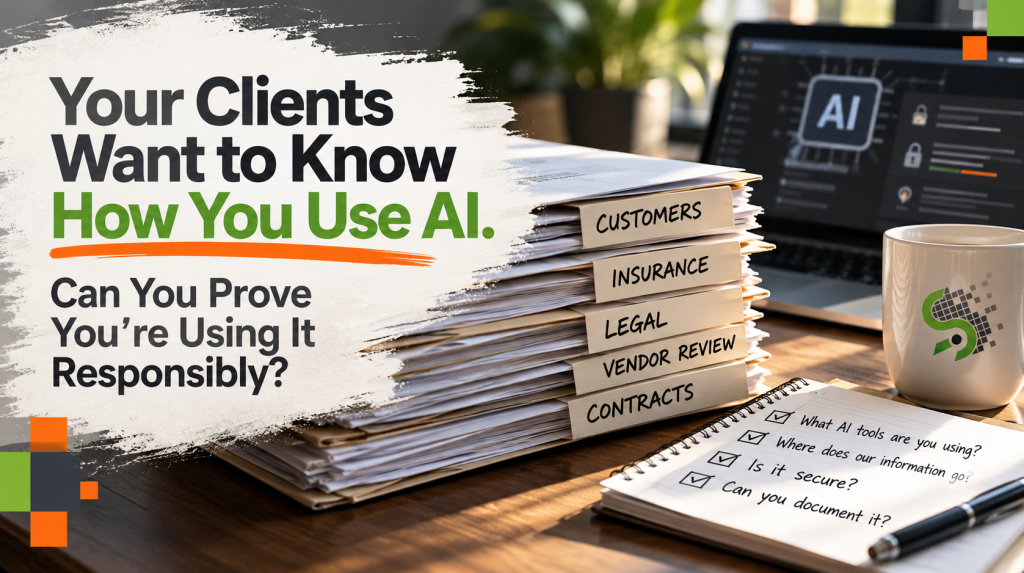
The people you do business with are going to want to know how you're using AI, what risks it introduces, and whether you've taken reasonable steps to manage those risks. More importantly, they may ask you to prove it.
It's Not Just Your Decision Anymore
Think about how cybersecurity has evolved over the past decade. There was a time when businesses largely made their own decisions about security. Today, customers, insurance providers, legal teams, and business partners routinely ask questions about how information is protected. AI is becoming part of that same conversation.
A customer may want assurance that its confidential information isn't being entered into an unapproved AI platform. An insurance provider may ask about AI usage and related controls when evaluating coverage. Legal counsel may want to understand whether AI introduces new contractual, privacy, or liability concerns. And a prospective customer, particularly a larger organization, may include AI-related questions in its vendor evaluation process.
None of these questions necessarily means your business is doing something wrong. They reflect a reasonable expectation that organizations understand the technologies they're using and the responsibilities that come with them. For small businesses, that expectation matters. You don't have to be a large corporation to handle sensitive information or be accountable for protecting it.
Having a Policy Isn't the Same as Managing the Risk
Imagine a prospective customer asks your business whether employees are permitted to enter confidential information into AI tools.
You respond that your company has an AI policy prohibiting it.
That's a good start.
But what if the customer asks:
- How do you know employees are following that policy?
- Which AI tools are approved?
- Whether information is retained by those platforms?
- Or what happens if an employee inadvertently exposes sensitive data?
Those questions require more than a written policy. They require some understanding of where AI is being used, what information it can access, how the tools are configured, and what safeguards are in place. This doesn't mean every business needs a complicated compliance program. It means businesses need to move beyond simply telling employees to be careful. There's a difference between saying you're using AI responsibly and being able to demonstrate it.
The Good News: Responsible AI Makes Adoption Easier
AI governance can sound intimidating, particularly to smaller organizations without dedicated compliance or security teams. But the objective isn't to bury businesses in documentation or discourage employees from using tools that make them more productive. It's to establish enough visibility and structure that businesses can adopt AI with confidence.
That starts with a few practical steps:
- Know what you're using. Identify the AI tools employees are using, including features built into existing software.
- Understand the exposure. Determine what company, employee, and customer information those tools can access.
- Set reasonable boundaries. Establish approved uses, information-handling expectations and appropriate human oversight.
- Document your decisions. Maintain evidence of your risk assessments, policies, safeguards and employee training.
- Review periodically. AI technology and vendor practices change, so your approach needs to evolve with them.
There are established resources to help. The National Institute of Standards and Technology (NIST) provides an AI Risk Management Framework, while ISO/IEC 42001 establishes an international standard for AI management systems. Not every business needs formal certification, but these frameworks reinforce an important point: AI risk can be evaluated and managed systematically. And when a customer or insurer asks how your organization approaches AI, having that information readily available can make the conversation considerably easier.
This Is About Trust, Not Just Technology
For small businesses, trust is often one of their greatest competitive advantages. Customers want to know that their information is being handled responsibly. Business partners want confidence that new technology won't introduce unnecessary exposure. Insurance providers and legal counsel want to understand risks before those risks become problems.
Businesses that can answer those questions clearly may have an advantage over competitors who haven't given the subject much thought. And there's an additional benefit: Understanding your AI environment makes it easier to identify opportunities to use the technology more effectively.
Can Your Business Demonstrate Responsible AI Use?
You don't have to figure this out on your own.
At IntegraMSP, we've developed an AI Readiness Risk Assessment to help small and midsize businesses understand how AI is being used within their organizations, identify potential risks, and establish a practical path toward responsible adoption.
We assess your existing AI usage, data exposure and relevant security considerations. From there, we work with you to develop a practical roadmap that addresses identified risks, establishes priorities, and helps your business move toward responsible AI adoption.
It's not about slowing down innovation or creating unnecessary paperwork. It's about giving your business the visibility, information and direction needed to make informed decisions and prepare for questions from customers, insurers and legal counsel.
Don't wait until a prospective customer asks for documentation you don't have.
Learn more about IntegraMSP's AI Readiness Assessment.
Because using AI responsibly is good business. Being able to demonstrate it builds trust.