
By: Jennifer Gilligan, IntegraMSP President
In the previous article, we examined the risks associated with running construction accounting systems on fragile or aging servers. But infrastructure risk does not end once a system is modernized or moved off a single machine.
Accounting platforms in construction environments operate within a broader technical ecosystem. Payroll applications feed ERP systems. Field data syncs into job cost reporting. Remote users access financial systems from offices and job sites. Background services run scheduled processes that move and validate information. Identity controls manage permissions and authentication across systems.
When firms evaluate accounting integrations, the conversation often centers on whether those systems are connected. The more consequential question is whether the network and infrastructure supporting those connections are stable, monitored, and properly maintained.
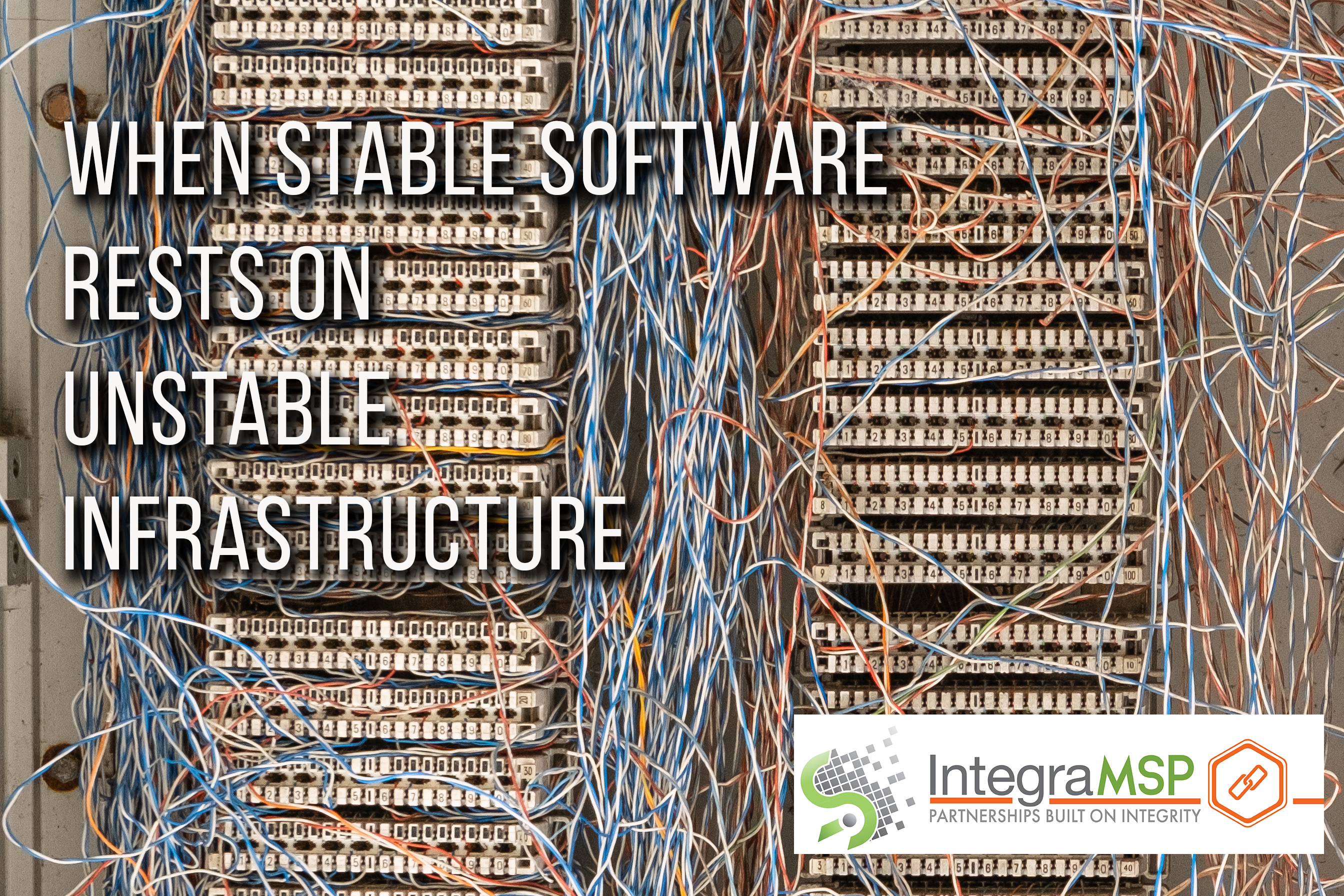
Financial applications rely on multiple technical layers to function correctly. Network reliability, server performance, database health, credential management, and secure remote access all play a role in maintaining data consistency. If one of these layers becomes unstable, integrations rarely fail in dramatic or obvious ways. Instead, they degrade.
A background service may stop running without immediate notice. A server experiencing resource strain may delay reporting processes. An expired credential may interrupt communication between systems. A network bottleneck may slow synchronization between field applications and accounting platforms.
In most cases, the software itself is not the root cause. The instability exists in the environment supporting it.
The impact of that instability is often subtle at first. Accounting teams begin reconciling minor discrepancies. Project managers question whether reports reflect current job cost data. Leadership requests additional validation before making financial decisions. Spreadsheets emerge as verification tools, not because the ERP is inherently flawed, but because confidence in the environment has weakened.
Over time, that erosion of trust creates operational drag. Decision-making slows. Manual work increases. Reporting timelines extend. Compliance exposure grows incrementally rather than catastrophically.
Mature construction IT environments address this risk by treating financial systems as mission-critical infrastructure rather than ordinary applications. That approach includes active monitoring of servers and cloud environments, visibility into network health, oversight of critical services and scheduled processes, and disciplined management of credentials and access controls. It also requires secure and reliable remote access for accounting teams and leadership.
This does not involve auditing payroll calculations or redesigning accounting workflows. It involves ensuring that the systems responsible for those functions operate within a stable, secure, and observable environment.
In construction, financial clarity depends not only on well-configured software but also on the reliability of the infrastructure beneath it. When that foundation is stable, reporting remains consistent, and leadership can make decisions with confidence. When it is not, instability often surfaces as hesitation, reconciliation, and delay rather than overt system failure.
In the next article, we will examine a related issue: backup strategies that exist in theory but have not been validated through full recovery testing. Monitoring supports stability, but resilience is measured by the ability to restore operations under real conditions. If you need a second pair of eyes on your critital IT infrastructure, give us a call.