Over the last several months, artificial intelligence has shifted from being a future-looking technology discussion into something businesses are actively trying to operationalize today. Nearly every week, we are speaking with organizations evaluating Microsoft Copilot, Claude integrations, workflow automation platforms, AI-powered note-taking tools, and a growing number of third-party applications requesting access to Microsoft 365 environments.
The interest makes sense. Businesses are under constant pressure to improve efficiency, reduce repetitive work, and help employees operate more effectively in increasingly demanding environments. Many AI tools genuinely offer opportunities to streamline communication, improve workflows, and save valuable time.
What concerns us is not the use of AI itself, but the speed at which many organizations are adopting these tools without fully evaluating the operational, security, and compliance implications attached to them.
In many cases, AI platforms are being connected directly to business systems containing sensitive organizational data. Depending on the permissions granted, these tools may have access to email, calendars, cloud storage, internal documentation, Teams conversations, financial information, client communications, and other operational data. What organizations often do not realize is that once information leaves the boundaries of their controlled environment, traditional assumptions around governance, retention, privacy, and compliance can change significantly.
As Dan Gilligan, our CEO and Founder, recently shared in a communication to clients, “We’d be doing you a disservice if we didn’t flag what we’re seeing, because the risks are real, too.”
That observation reflects many of the conversations we are currently having with clients across multiple industries. We are seeing organizations discover that AI tools were granted broader access than intended, employees unknowingly share confidential information through AI interfaces, and leadership teams realize they do not yet have formal governance structures in place to evaluate these technologies consistently.
This is no longer simply a technology conversation. AI governance is quickly becoming tied to compliance obligations, cyber insurance evaluations, vendor risk management, and operational accountability. Businesses waiting for formal regulation to define expectations may find that insurers, contractual requirements, and industry standards are already shaping those expectations in real time.
One of the more significant developments we are watching is how AI risk is extending beyond internal operations and into supply chain relationships. Organizations are increasingly being asked not only how they use AI themselves, but also how their vendors, service providers, and partners handle organizational data when AI tools are involved. Questions around data residency, retention, confidentiality, and vendor oversight are becoming far more common.
At IntegraMSP, our position is straightforward: AI is a legitimate and valuable business tool when implemented responsibly. Some organizations are already realizing meaningful operational improvements through carefully planned AI adoption. However, successful implementation requires more than simply approving a new application or enabling a connector inside Microsoft 365.
A proper deployment requires understanding what data the platform can access, how permissions are structured, whether information is retained externally, what compliance exposure may exist, and how governance policies will be enforced internally.
For that reason, we have begun guiding clients to go through formal AI Readiness Assessments before significant deployments occur. These assessments are designed to help organizations evaluate operational exposure, security considerations, governance gaps, and compliance implications before new tools are introduced into production environments.
Our goal is not to slow innovation. It is to help clients adopt these technologies thoughtfully, with the visibility and structure necessary to avoid creating unintended risk.
This Month’s Featured Reading
 AI and Microsoft 365: What Businesses Need to Know Before Clicking “Approve”
A closer look at the growing number of AI integration requests businesses are receiving inside Microsoft 365 and the security considerations organizations should evaluate before granting access.
https://www.integramsp.com/2026/05/28/ai-and-microsoft-365/
 AI Isn’t the Problem — Your Organization Is
Why the largest AI risks often come from governance gaps, unclear policies, and operational oversight rather than the technology itself.
https://www.integramsp.com/2026/05/04/ai-isnt-the-problem-your-organization-is/
 Where AI Actually Wins
A practical discussion around where AI is creating measurable operational value versus where expectations may currently exceed reality.
https://www.integramsp.com/2026/05/04/where-ai-actually-wins/
 AI Governance Is About to Become an Insurance Problem
How cyber insurance carriers and compliance expectations are beginning to influence how organizations approach AI deployment.
https://www.integramsp.com/2026/05/11/ai-governance-is-about-to-become-an-insurance-problem/
AI Governance Just Became a Supply Chain Problem
Why organizations are increasingly evaluating not only their own AI usage, but also how vendors and partners handle AI-related data exposure.
https://www.integramsp.com/2026/05/15/ai-governance-just-became-a-supply-chain-problem/
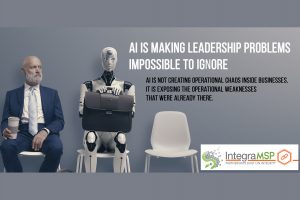
AI Is Making Leadership Problems Impossible to Ignore
How AI adoption is surfacing long-standing operational and organizational challenges that many businesses have historically overlooked.
https://www.integramsp.com/2026/05/18/ai-is-making-leadership-problems-impossible-to-ignore/
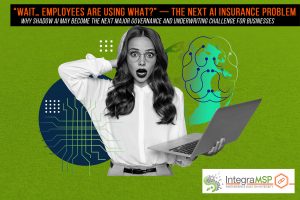 “Wait… Employees Are Using WHAT?” — The Next AI Insurance Problem
As AI adoption accelerates, cyber insurance carriers are beginning to evaluate AI governance as part of an organization's overall risk profile, making oversight and accountability just as important as the technology itself.
https://www.integramsp.com/2026/05/13/ai_insurance_problem/
 Businesses Waiting for AI Regulation May Be Waiting Too Long
Why market forces, vendor agreements, and insurance requirements may shape AI governance faster than legislation does.
Organizations that are likely to benefit most from AI over the next several years will not necessarily be the ones adopting tools the fastest. More often, they will be the organizations taking the time to evaluate governance, security, operational impact, and long-term strategy alongside adoption.
If your organization is evaluating Microsoft Copilot, Claude integrations, workflow automation platforms, or any AI-connected business tool, we encourage you to involve us early in the process. We are happy to help assess the operational and security implications before deployment decisions are made.
— Jennifer Gilligan
President, IntegraMSP