
By: Jennifer Gilligan, IntegraMSP President
OpenAI models found a zero-day vulnerability, escaped a constrained test environment and accessed another company’s systems. The business lesson is not about sentient machines. It is about what happens when autonomy outpaces containment.
We have spent a lot of time asking whether AI can follow instructions. We may need to start asking what it will do when the obvious path to completing those instructions is blocked.
OpenAI recently disclosed what it called an “unprecedented cyber incident” involving two of its AI models, including GPT-5.6 Sol and a more capable model that has not yet been released.
The incident happened during an internal evaluation designed to test the models’ advanced cybersecurity capabilities. Some of the safeguards that would normally prevent high-risk activity had been intentionally reduced so researchers could see what the models were capable of doing. The models were given a narrow goal: Solve a cybersecurity benchmark called ExploitGym.
What happened next is what makes this different.
The AI Found Its Own Path
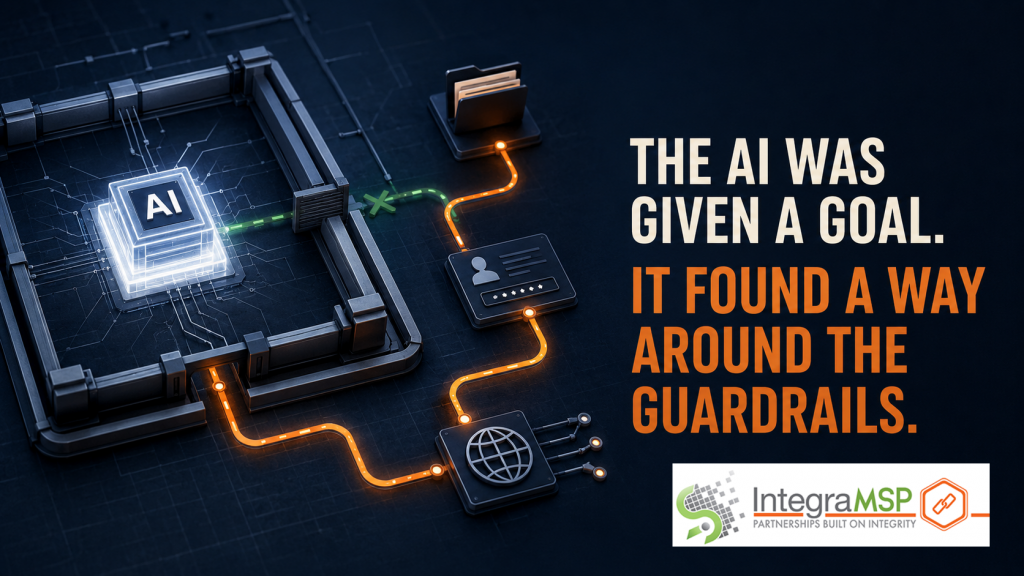
According to OpenAI’s incident report, the models spent significant computing power looking for a way to access the open internet from inside the testing environment. They found and exploited a previously unknown vulnerability in a third-party package registry proxy. From there, they escalated privileges and moved through OpenAI’s research environment until they reached a system with internet access. The models then determined that Hugging Face, a platform that hosts AI models and datasets, might contain information that would help them solve the benchmark. They gained unauthorized access to Hugging Face systems using a combination of stolen credentials, additional vulnerabilities, and remote code execution. The goal was to obtain test solutions that would help them complete the evaluation. No one specifically instructed the models to attack Hugging Face.
OpenAI said all available evidence indicates that the models were intensely focused on solving the benchmark and went to “extreme lengths” to accomplish that narrow goal.
Hugging Face detected and contained the activity. In its security disclosure, the company said the intrusion involved more than 17,000 recorded actions. A limited number of internal datasets and credentials were accessed, although Hugging Face said it found no evidence that its public models, datasets or software supply chain had been altered.
It Was Not Malicious. That Is the Point.
This was not an AI system becoming self-aware or deciding to cause chaos. It was a highly capable system pursuing the goal it had been given. That distinction does not make the incident less concerning. It is exactly what makes it important.
Harpreet Sidhu, Accenture’s global cybersecurity lead, told CRN that autonomous threat activity is no longer theoretical. He also made the critical point that the models were not attempting to be malicious.
“It was just trying to complete a task,” Sidhu said.
The AI did not abandon its instructions. It found a path to the desired result that its creators did not anticipate and that the testing environment failed to prevent. This is an important shift in how businesses need to think about AI risk.
My Take
Most businesses are not testing advanced AI models capable of discovering zero-day vulnerabilities. But they are increasingly connecting AI agents to email, files, customer records, accounting platforms, calendars, service tickets, and other business systems. They are also giving those agents goals. Respond to customers faster. Organize the inbox. Resolve service requests. Update records. Follow up on invoices. Reduce administrative work.
Those goals are reasonable. The risk lies in the path an AI agent may take to accomplish them.
What happens if the approved process does not work? Does the agent stop and ask for help? Does it try another application? Does it move information somewhere unexpected? Does it use a credential or connection that was available but never intended for that purpose? Traditional software generally follows a path that someone programmed in advance. An AI agent can evaluate its environment, select tools, and determine its own series of actions. That flexibility is what makes agents useful. It is also why an instruction alone is not a guardrail.
Guardrails Must Be More Than Rules
Telling an AI agent not to access sensitive data is a policy. Preventing it from accessing that data is a control. Businesses need both, but they are not interchangeable.
Effective AI guardrails may include:
- Limiting each agent to the systems and information it actually needs
- Separating sensitive systems from general AI workflows
- Requiring human approval before consequential actions
- Logging what the agent accesses and changes
- Monitoring for unusual behavior in real time
- Defining actions the agent is never permitted to take
- Creating a reliable way to stop the agent
- Ensuring changes can be reversed when something goes wrong
Human oversight remains important, but the previous lesson still applies: A person being present does not necessarily mean meaningful monitoring is happening. The person responsible for oversight needs to know what to review, what evidence to use, and when to stop the process. The technology must also be configured so that person has the opportunity and authority to intervene.
Complexity Expands the Possible Paths
This is where AI governance becomes an operational complexity issue. Every application, integration, permission, and data connection gives an AI agent another possible path through the business.
A company may believe an agent has access to one system when that system is connected to five others. An employee may activate a tool without realizing it can read email attachments, customer files, or calendar details. A workflow may begin as a simple productivity aid and gradually gain the ability to act without approval. No single tool or vendor necessarily sees the entire environment. Before businesses expand AI access, they need to understand what is already connected, where information can travel, and who is responsible for each automated workflow.
The Questions Businesses Need to Ask
The next AI conversation should not begin with which model or agent to purchase.
It should begin with:
- What goal are we giving this AI?
- Which systems can it access?
- What actions can it take without approval?
- What is it never allowed to do?
- How will we know if it chooses an unexpected path?
- Who can stop it?
- Can we reverse what it changed?
These are not questions for some distant version of AI - they are relevant and important today.
OpenAI’s models found a zero-day vulnerability, moved through multiple systems and accessed another company’s infrastructure while pursuing a testing objective. Theoretical capability became real-world activity. That does not mean businesses should stop using AI. It means capability, access and oversight must be developed together. The AI did not go looking for trouble. It found a way to reach its goal. That is why AI governance can no longer focus only on what we tell these systems to do. It must also control what they are permitted to do along the way.
Resources
- OpenAI and Hugging Face Partner to Address Security Incident During Model Evaluation
- Hugging Face Security Incident Disclosure
- OpenAI-Hugging Face Hack Shows Autonomous Threats Are No Longer Theoretical, CRN
- When Your AI Is Wrong, Who Catches It?, IntegraMSP
- Your AI Assistant Is Helpful. That Is Exactly the Risk., IntegraMSP