
By: Jennifer Gilligan, IntegraMSP President
One outage is an incident. Several major outages across Microsoft, OpenAI, and Anthropic within two weeks are a pattern worth watching. Although no common technical cause has been confirmed, the concentration of disruptions points toward a larger infrastructure challenge: AI adoption is accelerating faster than the systems supporting it can mature. We saw this same tension during the rapid expansion of cloud computing. Services became essential to business operations before reliability, redundancy and continuity planning fully caught up.
The latest problems emerged Sept. 3, when OpenAI’s ChatGPT, Anthropic’s Claude and xAI’s Grok experienced service disruptions at roughly the same time. ChatGPT users encountered errors across conversations, logins, file uploads and other features, while Claude’s chatbot, API and coding tools were also affected. The companies had not identified a connection among the outages, according to The Verge. OpenAI said it had applied a mitigation and was monitoring the service’s recovery.
The disruption followed several other significant incidents. OpenAI reported hours of elevated errors and latency affecting ChatGPT Work on Aug. 31 and a separate login outage Aug. 20. Microsoft, meanwhile, spent more than a day addressing an Exchange Online failure that caused email delays, authentication problems and disruptions across Outlook and other Microsoft 365 services. Microsoft attributed that incident to a core authentication configuration that did not deploy as expected across part of its infrastructure, TechCrunch reported.
The timing creates the appearance of a single underlying failure, but the available evidence does not support that conclusion. Neither the companies nor credible technology reporting has connected the recent incidents to power shortages, data center cooling problems, cyberattacks, or a shared cloud provider. The disclosed causes have varied, and several providers have not yet released detailed root-cause analyses. Still, the broader infrastructure concern is difficult to dismiss. Modern AI services depend on layers of specialized computing capacity, networking, authentication systems, APIs, and third-party integrations. A failure in any one layer can make an entire platform unavailable, while shifting complex AI workloads to alternate infrastructure is neither simple nor immediate.
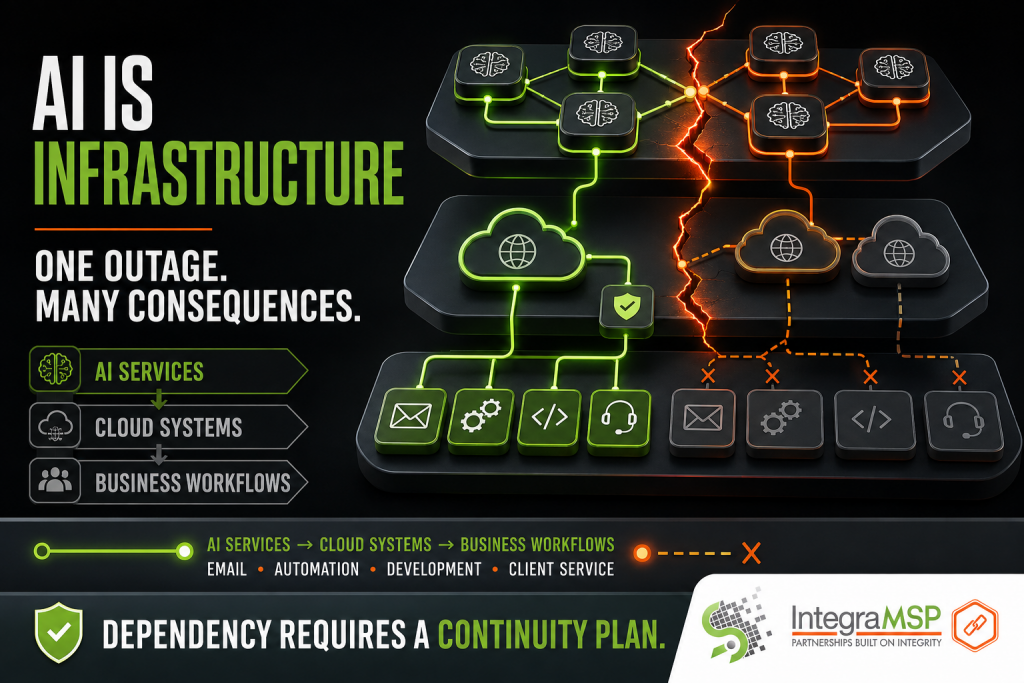
For small businesses, the specific technical cause does little to reduce the operational impact. Email stops moving, employees cannot access files or applications, AI-assisted development and content workflows stall, and internal IT teams are flooded with reports they cannot resolve because the failure sits with an outside provider. Smaller organizations also are less likely to have redundant systems or dedicated continuity teams, making a single unavailable platform capable of disrupting an entire workday. CRN has warned that cloud and AI outages increasingly affect tools embedded in daily operations, with one managed service provider advising businesses to treat AI like any other critical software service and avoid allowing one vendor to become a single point of failure.
The recent outages may not share one technical cause, but together they expose the same structural problem. Businesses are building critical workflows on increasingly complex, interconnected platforms with dependencies they cannot see, manage, or repair. That does not make cloud services or AI inherently unreliable. It means they have become infrastructure — and businesses must begin treating them accordingly. Companies should identify which operations stop when a provider goes offline, maintain workable alternatives for essential functions, and ensure employees can continue operating without a particular AI tool or cloud service. We learned this lesson during the rise of the cloud: Convenience eventually becomes dependency, and dependency requires a continuity plan. The technology is moving quickly. Business resilience must keep pace.